About Gonyosoma frenatum (Gray, 1853)
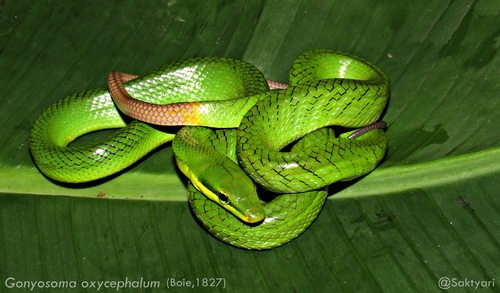
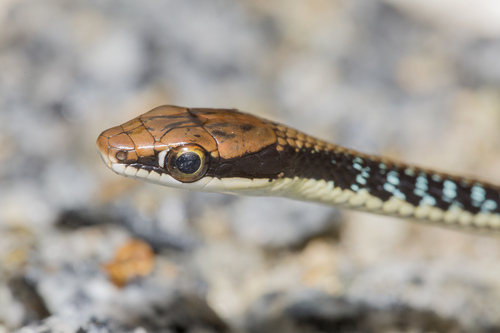
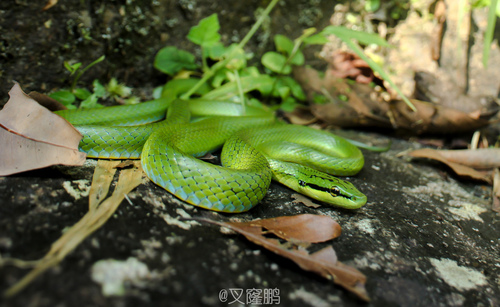
Gonyosoma frenatum, first described by Gray in 1853, reaches approximately 84 cm (2 feet 9 inches) in total body length, with a tail that measures 24 cm (9.5 inches). The dorsal surface of this species is uniformly bright green, with a black streak running along each side of the head that passes through the eye. The upper lip and lower body are pale green, and the species has a whitish ventral keel. Its snout is subacuminate, twice as long as the eye, obliquely truncated, and projecting. The rostral scale is slightly broader than it is deep, and is barely visible when viewed from above. The suture between the internasals is much shorter than the suture between the prefrontals. The frontal scale is the same length as the distance from the frontal scale to the end of the snout, and is shorter than the parietal scales; no loreal scale is present. The prefrontal scale is in contact with the labial scales. This species has one large preocular scale, two postocular scales, temporals arranged in a 2+2 or 2+3 pattern, and 9 (or rarely 8) upper labials, with the fourth, fifth, and sixth upper labials entering the eye. Five lower labials are in contact with the anterior chin shields, which are the same length as the posterior chin shields. Dorsal scales are arranged in 19 rows, and are faintly keeled. Ventrals have a lateral keel, number between 203 and 204, the anal scale is divided, and subcaudals number between 120 and 121. This species is distributed in northeastern India (Assam and Arunachal Pradesh), southern China (extending to southwestern Sichuan, and found in Fujian, Guangdong, Anhui, Guangxi, Guizhou, and Zhejiang), Taiwan, and northern Vietnam. Its type locality is Khasi Hills, India, as recorded by Gray in 1853.