About Gonialoe variegata (L.) Boatwr. & J.C.Manning
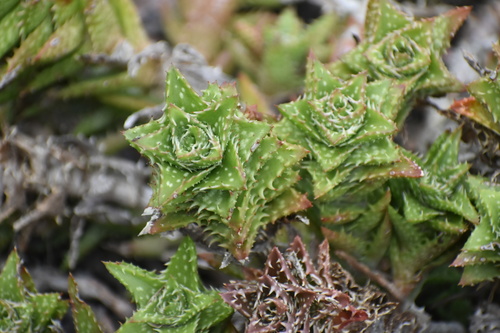
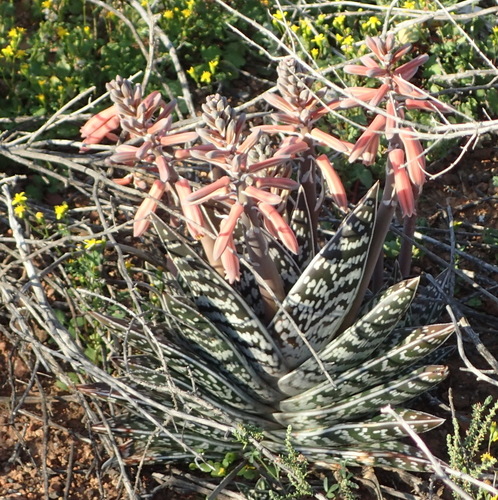
Gonialoe variegata, commonly called tiger aloe, grows to around 20–30 cm (7.9–11.8 in) tall, with 18–24 leaves arranged in three distinct vertical ranks. New leaves emerge one at a time from the plant's centre, pushing older leaves outward into a spiral shape and flattening them as they grow. Each leaf is a deep rich green marked with irregular light green bands formed by merged, slightly raised oval spots, and has fine, light-coloured serrations along both edges. In mature plants, the outermost, oldest leaves measure 10–15 cm (3.9–5.9 in) long, and approximately 3–6 cm (1.2–2.4 in) wide at the base. Outer leaves die off in response to physical damage, growing space limitations, water availability, or old age; dying leaves turn golden brown and shrivel away as they are shed. Plants reach maturity between three and seven years, with the timeline heavily dependent on available growing space, sunlight, and water. Once mature, plants produce upright flower racemes, which can reach 20–30 cm (7.9–11.8 in) in height. Flowers start as a tight cluster at the tip of the raceme, and become spaced out as the raceme elongates rapidly. The flowers are orange. In its native southern African habitat, flowering occurs from July to September, and the plant readily produces new offsets. This species is indigenous to the arid Karoo region of southern Africa. Within South Africa, it grows across dry areas of the Western Cape, Eastern Cape, Northern Cape, and Free State. It most commonly grows on rocky terrain and outcrops, often growing in gaps between boulders, but can also grow in sharply drained soils such as sandy soils. It is typically found in semi-shade, sheltered from full sun in rock crevices or beneath shrubs, and is the dominant plant species in winter-rainfall areas of the region. Moving northward as the climate shifts to a summer rainfall pattern, G. variegata is replaced first by its sister species Gonialoe sladeniana in the intermediate rainfall zone, which is in turn replaced by Gonialoe dinteri in the summer rainfall areas of far northern Namibia. Like most aloes, G. variegata produces reddish nectar-rich flowers that attract sunbirds, which are thought to be the species' main pollinators. Other common visitors to the flowers include insects such as bees, wasps, beetles, and ants. In temperate regions, this aloe can be grown outdoors during the summer. It does not tolerate temperatures below 5 °C (41 °F) or consistently wet conditions, so it requires glass protection over winter in these climates. When grown in cultivation in the United Kingdom, this plant received the Royal Horticultural Society's Award of Garden Merit in 1993.