About Gomphrena celosioides Mart.
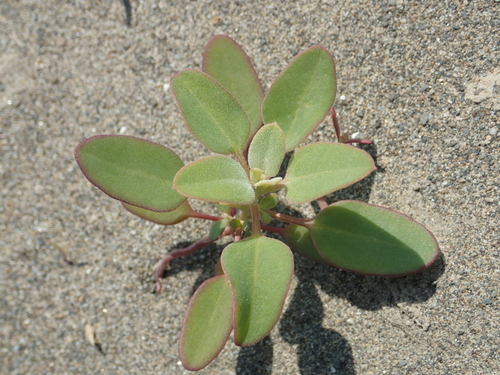
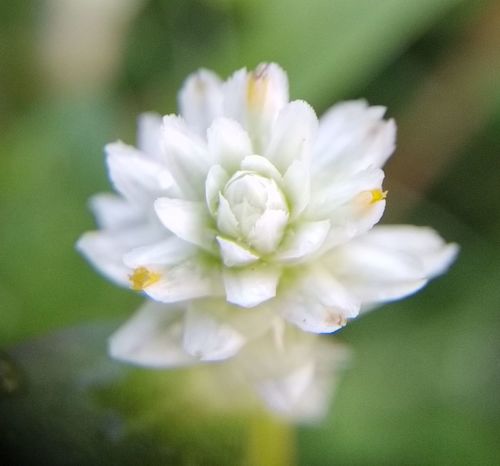
The scientific name Gomphrena celosioides Mart. translates from Greek and Latin: 'gomphos' means club, and 'celosioides' means resembling Celosia. Gomphrena celosioides is a herbaceous perennial flowering plant in the Amaranthaceae family, one of 51 species in the genus Gomphrena. It is a cosmopolitan pioneer plant that grows in disturbed areas. This species is a much-branched, prostrate plant that can be mat-forming; it may grow as an annual or short-lived perennial, and has a deep taproot. Its leaves are opposite and elliptical, with short, hairy petioles. The leaves are covered in fine hairs, and reach about 4 cm (1.6 in) in length. Its flowers form dense terminal spikes, growing on a woolly receptacle. The perianth segments are papery, 4–6 mm (0.16–0.24 in) long, with a shiny texture, and range in colour from whitish to pink. The plant has 2 stigmas and 5 stamens inserted opposite the sepals, joined into a 5-toothed staminal tube. It has a superior ovary that develops into a single-seeded fruit. The seed is about 1.5 mm (0.059 in) long, lentil-shaped, brown, and glossy, and it is regularly distributed by ants. Gomphrena celosioides is native to the Americas, specifically Argentina, Bolivia, Brazil, Ecuador, Paraguay and Uruguay. It has become naturalised across a wide range: in Asia it occurs in Bhutan, China, Indonesia, Japan, New Caledonia, Philippines, Singapore, Sri Lanka, Papua New Guinea, Taiwan, Thailand, and Vietnam; in the Pacific region it is found in New Zealand, Christmas Island, Australia, and Hawaii; and in the African region it occurs in Botswana, Cameroon, Egypt, Eritrea, Eswatini, Ethiopia, Ghana, Guinea, Kenya, Lesotho, Madeira Islands, Malawi, Mauritius, Mozambique, Namibia, Réunion, Rwanda, Socotra, South Africa, Tanzania, Uganda, Zaire, Zambia and Zimbabwe.