About Gompholobium latifolium Sm.
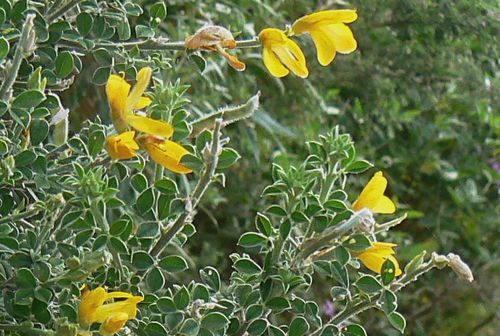
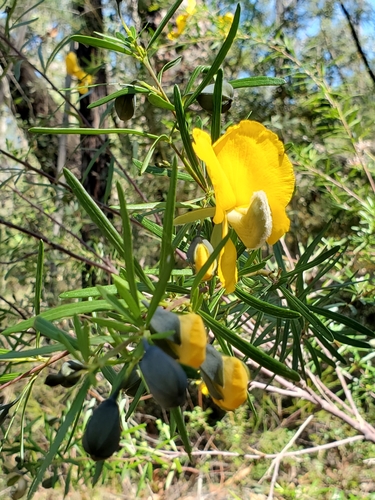
Gompholobium latifolium Sm. is an erect, glabrous shrub that typically grows up to 3 m (9.8 ft) tall. Its leaves are made up of three linear to lance-shaped leaflets, most of which are 25–50 millimetres (1–2 in) long and 2–6 millimetres (0.08–0.2 in) wide. The leaves have a very short stalk, and their upper surface is darker than the rest. The flowers are yellow, arranged singly or in groups of up to three in leaf axils or at the ends of branches, on a stalk about 10 mm (0.4 in) long. The five sepals are about 12 mm (0.5 in) long, joined only near their base. They are lance-shaped, dark green and glabrous on the outside, and covered with flattened, matted hairs on the inside. The standard petal is 20–30 mm (0.8–1 in) long. The keel is sometimes greenish, and is always densely hairy along its edge, with hairs growing up to 1 mm (0.04 in) long. Flowering mostly occurs from September to November. After flowering, it produces an oval to roughly spherical legume fruit that grows up to 18 mm (0.7 in) long and 10 millimetres (0.4 in) wide, containing twelve to fifteen brownish, kidney-shaped seeds. This species, commonly called golden glory pea, grows in dry sclerophyll forest in Queensland, New South Wales and Victoria, Australia, in sandy soil. It is most common in New South Wales, where it is widespread along the coast and nearby ranges, and it is uncommon in Victoria. Gompholobium latifolium is a desirable horticultural species valued for its large yellow pea flowers, but it is uncommon in gardens. It can be propagated easily from seed, but viable seeds are often hard to obtain. Seeds must be boiled or scratched before they will germinate.