About Gompholobium grandiflorum Sm.
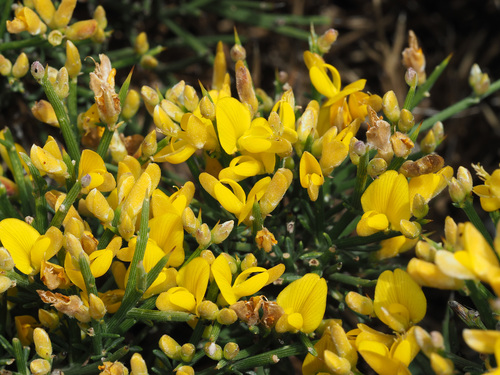
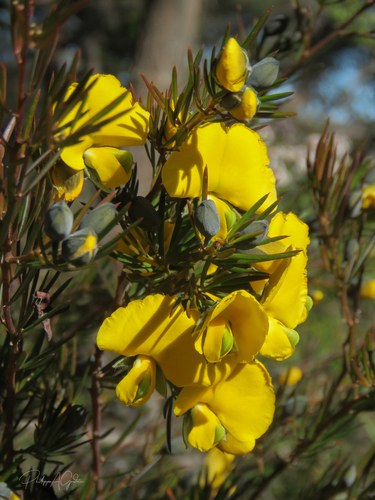
Gompholobium grandiflorum Sm. is an erect, more or less hairless shrub that usually grows between 1 and 2 meters (3 feet 3 inches to 6 feet 7 inches) tall. It has smooth stems that are often covered in small warts. Its leaves are trifoliate, made up of three narrow, linear leaflets that measure 11 to 33 millimeters (0.43 to 1.30 inches) long and 0.5 to 1.6 millimeters (0.020 to 0.063 inches) wide. Each leaflet ends in a sharp point, and its edges curve downward or roll under. The flowers are 15 to 25 millimeters (0.59 to 0.98 inches) long, and arranged singly or in small groups at the ends of branches. Each flower sits on a stalk called a pedicel that can grow up to 7 millimeters (0.28 inches) long. The sepals are about 12 millimeters (0.47 inches) long. The large upper petal (standard) and side petals (wings) are lemon-yellow, while the lower fused petal (keel) is greenish. Flowering can happen in almost any month of the year, but occurs mainly in spring. The fruit is an oval pod that grows up to 15 millimeters (0.59 inches) long. This species, commonly known as large wedge-pea, grows in forest and heath habitats on sandstone soils. It is found on the coast and adjacent tablelands of New South Wales in Australia, between Gosford and Jervis Bay, and extends inland as far as the Blue Mountains.