About Gompholobium ecostatum Kuchel
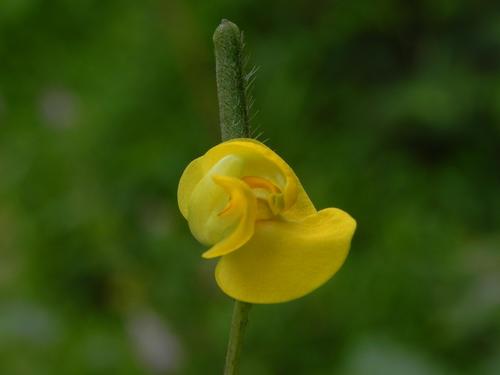
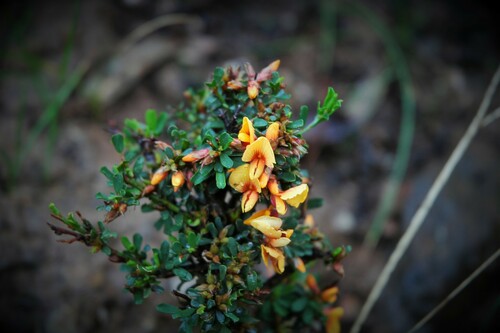
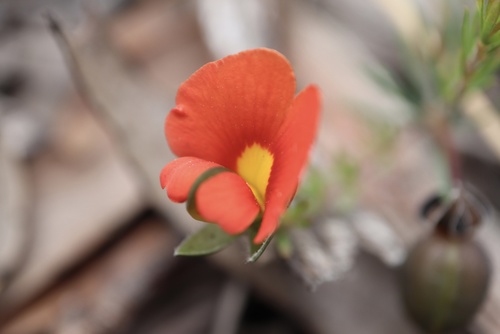
Gompholobium ecostatum, commonly known as dwarf wedge-pea, is a low-lying to erect shrub that typically reaches a maximum height of 50 cm (20 in). It has hairy, wiry stems. Its leaves are trifoliate, with leaflets that range from linear to narrow lance-shaped, measuring 3–15 mm (0.12–0.59 in) long and around 1 mm (0.039 in) wide. The leaflets are sessile, with rolled under edges. Tapering stipules, about 1 mm (0.039 in) long, grow at the base of each leaf. Flowers are borne singly or in pairs in leaf axils; each flower is 15–20 mm (0.59–0.79 in) long, on a pedicel that grows up to 10 mm (0.39 in) long. The sepals are up to 8 mm (0.31 in) long and hairless on the outer surface. The petals are apricot to reddish, and sometimes yellow. Flowering takes place from October to March. The fruit is an obliquely oval pod 10–12 mm (0.39–0.47 in) long. This species grows in heathland and woodland. Its distribution extends across southern Victoria from near Wilsons Promontory to Kangaroo Island in South Australia, inland as far as Little Desert National Park, and it also occurs on Flinders Island in Tasmania.