About Gomphocarpus physocarpus E.Mey.
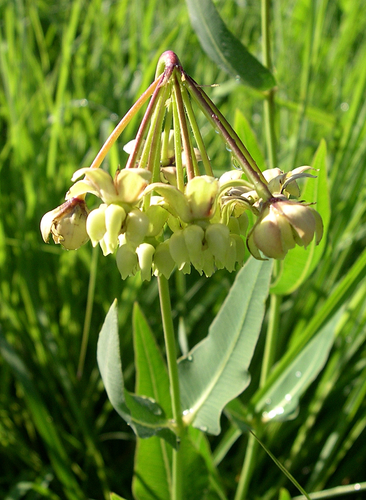
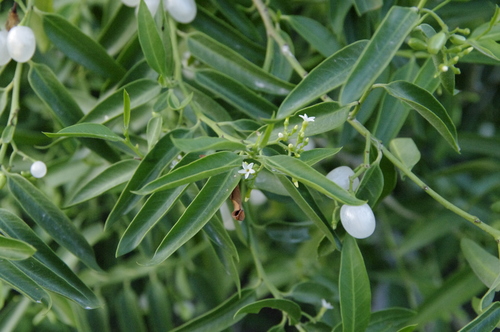
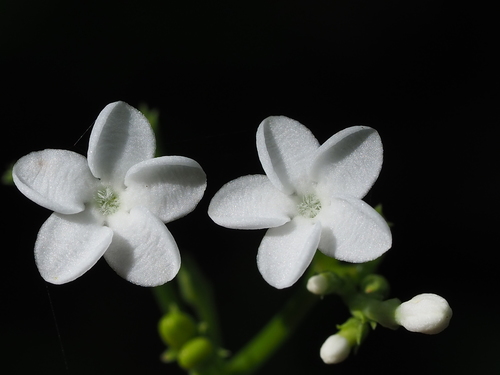
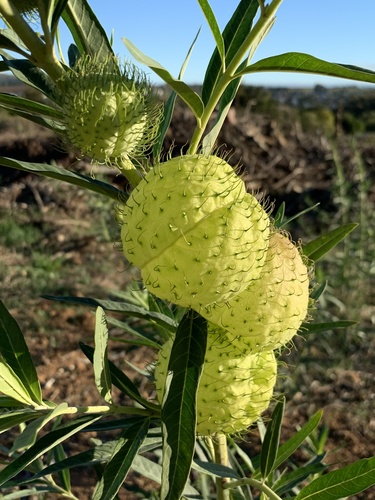
Gomphocarpus physocarpus E.Mey. is a perennial undershrub herb that can reach 2 meters (6 feet 7 inches) in height. It has light green leaves that are linear to lanceolate, measuring 7–10 cm (2.8–3.9 inches) long and 1.2 cm (0.47 inches) wide. Its small flowers grow to about 1 cm across, and feature white hoods. The plant's fruit is a pale green, inflated, spherical follicle filled with air, covered in rough hairs, that can reach 8 cm (3.1 inches) in diameter. Its brown seeds bear silky tufts. This species blooms during warm months. It grows on roadside banks at altitudes between 850 and 1,500 meters (2,790 and 4,920 feet) above sea level. It prefers full sun, moderate moisture, and sandy, well-drained soil. It can be propagated by either seeds or cuttings. Seeds should be sown in a light, well-drained substrate. Cuttings around 10 cm long, with their basal leaves removed, can be planted in a pot with a light, well-draining substrate. It readily hybridizes with Gomphocarpus fruticosus to produce intermediate forms. Its leaves and stems produce milky latex that contains carbohydrates, cardiac glycosides (cardenolides), terpenoids, alkaloids, and phenols. It has traditional uses: it is processed into ointments to treat warts, and its seeds are used in rituals. It is known by multiple common names: in Afrikaans these are balmelkbossie, balbossie, wilde kapok; in Zulu these are umbababa, umbemiso, umangwazane, umqumnqwewe, uphuphuma, usingalwesalukazi, umsingalwesalukazi. In ecological terms, this plant's stamens are fused to the style head, and all pollen from each stamen is held within two pollinia. The pouch-like structure formed by the petals around the plant's reproductive organs prompts pollinia to stick to the legs or proboscis of pollinating insects, which carry the pollen packets between individual plants. This species is self-incompatible, and these specialized structures support its reproductive strategy. It is a food source for caterpillars of Danaus butterflies, including the African monarch butterfly (Danaus chrysippus orientis). These caterpillars store the plant's toxic, unpleasant-tasting cardenolides to deter predators, and have distinct colouration to warn predators before an attack.