About Gomphidius glutinosus (Schaeff.) Fr.
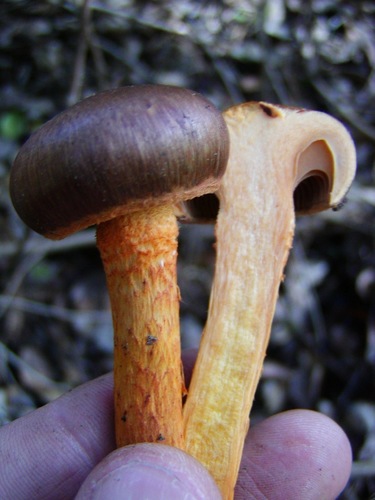
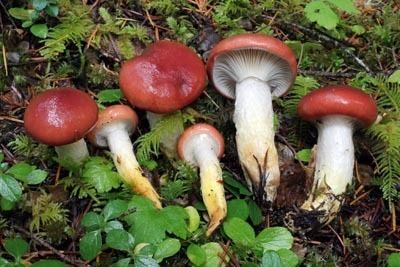
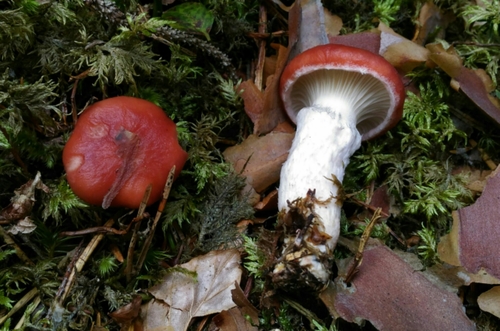
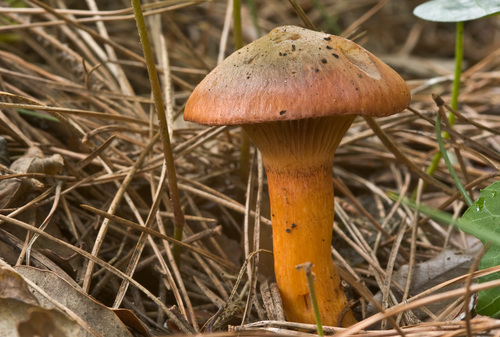
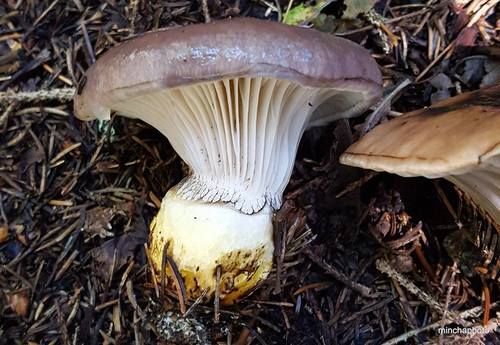
Gomphidius glutinosus (Schaeff.) Fr. is a mushroom whose overall shape is said to resemble a child's top. Its cap is dull dark purple, dark brownish, or greyish, and measures 3–12 cm (1+1⁄8–4+3⁄4 in) in diameter. It has a central raised boss, an inrolled margin, is initially convex, and later flattens, sometimes developing blackish markings. The cap surface is smooth and sticky. Like other species in the genus Gomphidius, the entire young mushroom is often covered with a slimy or sticky veil. As the fungus grows, it breaks free of the veil, leaving behind some strands and an indistinct ring. The white stipe is 4–10 cm tall and 0.7–2 cm wide, narrowing toward its yellow base. The yellow portion of the stipe stains dark green to black when treated with Melzer's reagent. The whitish flesh may have a faint wine-coloured tinge, and has very little distinct taste or smell. The gills are widely spaced and decurrent, with a waxy texture and a hairy surface created by cystidia. They are sometimes branched, initially whitish, turning grey as they mature, and later blackening as spores develop. The spore print of this species is brownish-black. Its large spores are spindle-shaped, measuring 17–20 μm long by 5.5–6 μm wide. Gomphidius glutinosus is distributed across Eurasia and North America, occurring at elevations up to 2,900 metres (9,600 ft), and is generally abundant throughout its range. It grows in autumn under various conifer species, in both natural forests and plantations, including balsam fir (Abies balsamea), Norway spruce (Picea abies), and grand fir (Abies grandis). Mushrooms may grow alone, scattered, or occasionally in clumps. Fruiting bodies emerge in autumn, and may appear as late as December in northern California. Like other members of the family Gomphidiaceae, Gomphidius glutinosus was long thought to be ectomycorrhizal, forming a symbiotic relationship with its host trees. However, new evidence indicates that many, and possibly all, species in this group are parasitic on ectomycorrhizal boletes, often in highly species-specific relationships – an example is Gomphidius roseus parasitizing Suillus bovinus. Two specimens of Gomphidius glutinosus were found in Brechfa Forest on July 25, 2009, where the only bolete found in the immediate area was Suillus grevillei. G. glutinosus is a hyper-accumulating fungus that absorbs and concentrates elements such as cesium at levels more than 10,000 times higher than background environmental concentrations. This property can be used to decontaminate sites contaminated with radioactive cesium-137.