About Gnorimus nobilis (Linnaeus, 1758)
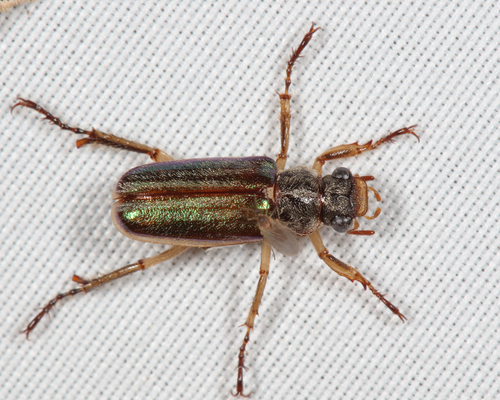
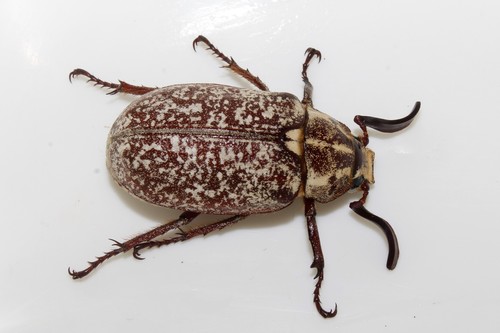
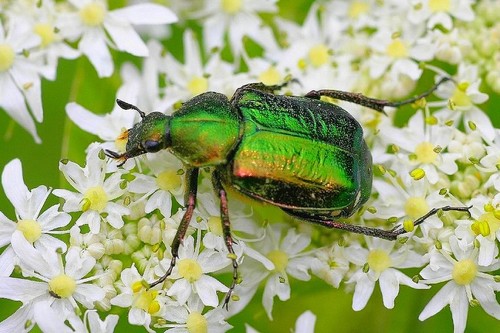
Gnorimus nobilis (Linnaeus, 1758), commonly called the noble chafer, reaches an adult body length of 15–19 millimetres (0.59–0.75 in). The pronotum and head of these beetles are covered in dense, medium-sized dots. Their elytra are marked with dense coarse wrinkles and small dots. Their body is metallic green, speckled with white, and has a brilliant iridescence that can range in color from gold to copper or violet. The sides of the abdomen and the pygidium are also gold-green, with large white spots, while the underside of the body ranges from bright coppery to black. This species can be easily distinguished from the related Gnorimus variabilis: G. variabilis has non-metallic green black elytra with white spots, and the lateral edge of its pronotum is weakly S-shaped, while the pronotum edge of G. nobilis is simply rounded. G. nobilis is also rather similar to the more common Cetonia aurata, but C. aurata has toothed middle and hind legs, while these legs are smooth in G. nobilis. Additionally, the scutellum of G. nobilis forms an equilateral triangle. This species is widespread across most of Europe, with recorded occurrences in Albania, Austria, Belarus, Belgium, Bosnia and Herzegovina, Bulgaria, Croatia, Czech Republic, Denmark, Estonia, France, Germany, Greece, Hungary, Italy, Latvia, Liechtenstein, Luxembourg, Montenegro, Netherlands, North Macedonia, Norway, Poland, Portugal, Romania, Russia, Serbia, Slovakia, Slovenia, Spain, Sweden, Switzerland, Turkey, Ukraine, and the United Kingdom. It is thought to be declining across most of its European range. In Britain, this beetle has been losing habitat and experiencing population shrinkage for more than a century; in recent years, it has only been observed at a small number of sites in the traditional English fruit-growing regions of Gloucestershire, Herefordshire, and Worcestershire. G. nobilis inhabits both plains and mountain areas, and prefers open deciduous woodlands, where it is associated with dead wood. In the United Kingdom, however, it is often found in old fruit orchards.