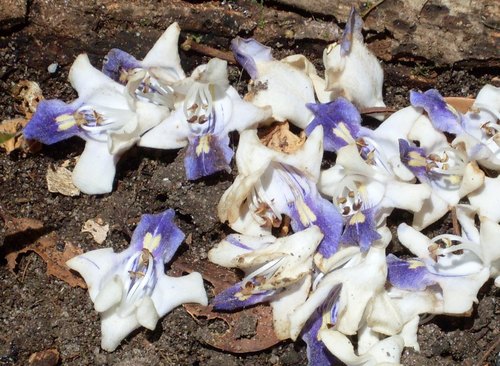
About Gmelina leichhardtii (F.Muell.) Benth.
Gmelina leichhardtii, commonly known as white beech, has mature specimens that reach 15 to 30 m (49 to 98 ft) tall, while exceptional individuals can grow to 60 m (200 ft) tall and live for centuries. The base of the largest trees exceeds two and a half metres in diameter, and the trunk is cylindrical, with a flanged but not buttressed base; flanging can extend up the tree bole. The bark ranges from light to dark grey, with a scaled surface and vertical cracks across sections of the trunk, and burls may be present. The species is considered semi-deciduous by some sources, losing part of its canopy in late spring. Green leaves almost always remain at the base of the tree, which helps with identifying the species. Branchlets are thick, grey or brown, hairy, and have easily visible leaf scars. New shoots are densely covered in fine fur. Mature leaves are pale green and ovate, measuring 8 to 18 cm (3.1 to 7.1 in) long, with a hairy and veiny underside. The midrib, lateral veins, and net veins are distinct on the upper leaf surface, and are conspicuously raised and distinct beneath the leaf due to a covering of fawn-colored hairs. There are eight to ten lateral veins, which are straight and fork near the leaf margin at a 45-degree angle to the midrib. Juvenile leaves have toothed edges. Flowers in shades of purple, yellow, and white form in late spring and summer. Fruit ripen from February to May. The main natural range of Gmelina leichhardtii extends from the Blackall Range and the area around Maleny, southward to the New South Wales south coast. Anders Bofeldt considers Broughtonvale (34½° S), near Berry, New South Wales, the southern limit of the species' natural distribution. However, D.J. Boland identifies the much more southerly Clyde River, New South Wales (35° S) near Batemans Bay, as the southern limit. Isolated populations occur in central-northern Queensland, in the Eungella Range and on Mt Elliot near Townsville. North of Sydney, the species was officially recorded in the Wyong area in 1916, and it is still present in rainforest along Ourimbah Creek. Before European settlement, dense populations of white beech grew in Caloundra. In the Illawarra region, white beech is rare and endangered, with fewer than one hundred trees likely remaining across around thirty different sites. While white beech trees can be seen along the Minnamurra Falls rainforest walk in Budderoo National Park in the Illawarra, these trees are not marked with signage. The species grows on mountain slopes and on alluvial soils along riverbanks; it even grows on sand hills on Fraser Island. Its usual habitat is subtropical rainforest, where trees grow either singly or in small stands of up to five individuals scattered through the forest. It is associated with tree species including yellow carabeen (Sloanea woollsii), red carabeen (Geissois benthamiana), Queensland kauri pine (Agathis robusta), golden sassafras (Doryphora sassafras), black booyong (Argyrodendron actinophyllum), white booyong (Argyrodendron trifoliolatum), and members of the genus Flindersia. In terms of ecology, the fruit of Gmelina leichhardtii is eaten by the topknot pigeon and the wompoo fruit dove. The timber of this species is durable, greyish, and without prominent markings, though it splits when nailed. It is valued for use in templates, pattern making, house construction, boat hull planking, flooring, carriage work, wood carving, and cabinet work. The timber weighs around 550 kg per cubic metre. This tree is well suited to planting in parks and large gardens, and it is also used as a shade tree on farms in former rainforest areas.