About Glyphorynchus spirurus (Vieillot, 1819)
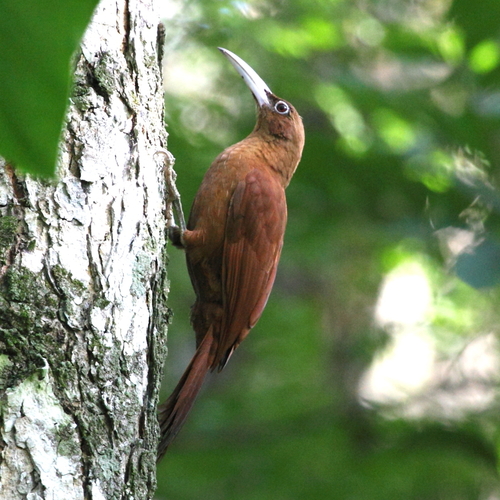
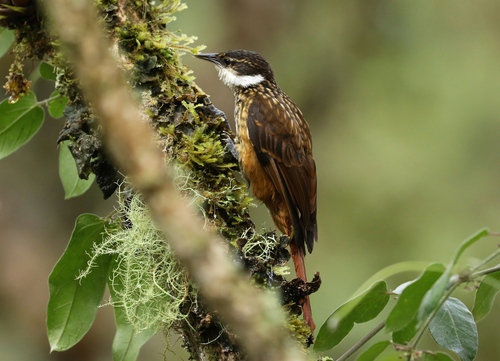
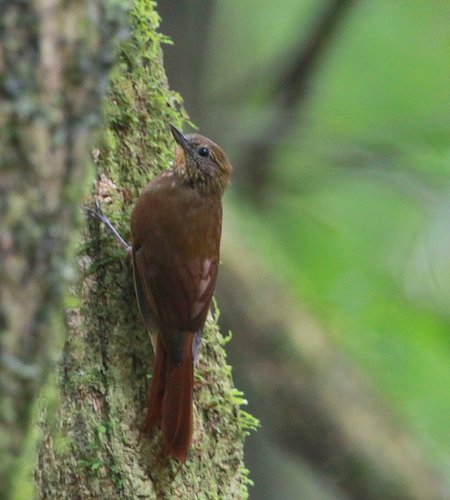
The wedge-billed woodcreeper, with the scientific name Glyphorynchus spirurus (Vieillot, 1819), is the smallest woodcreeper species. It has a short, upturned, wedge-shaped bill that resembles the bills of the three species in the genus Xenops. It measures 13 to 16 cm (5.1 to 6.3 in) in length and weighs 10.5 to 21 g (0.37 to 0.74 oz). The two sexes have identical plumage. The nominate subspecies G. s. spirurus has a grayish forehead, rich brown to russet-brown crown and nape, light buff lores, a thin buff to buff-white supercilium, a buff eyering, sooty-brown auriculars, and a brown malar stripe. Its upper back and scapulars are rich brown to russet-brown, while its lower back, uppertail coverts, and tail are cinnamon-rufous to rufous-chestnut. Its wing coverts are russet, its inner secondaries are rufous, and its remaining secondaries and primaries are dark brown with blackish tips. The underside of most wing feathers has a buff to buff-white stripe that appears as a band when the bird is in flight. The sides of its neck are brown with small buff spots, and its throat is whitish buff to buff with some dusky spots. Its underparts are olive-brown to russet-brown, its undertail coverts have a rufous-chestnut wash, and its underwing coverts and axillaries are white. Its upper breast has large round fulvous spots, and its lower breast has narrow streaks of the same fulvous color. Its iris is dark brown to amber, its bill is black with a gray base to the mandible, and its legs and feet can be pinkish gray, dark gray, dark greenish, or brownish black. Other subspecies of the wedge-billed woodcreeper differ from the nominate subspecies as follows: G. s. pectoralis has darker, more olivaceous underparts, a cinnamon-buff throat, and triangular markings on the breast; G. s. subrufescens is intermediate between pectoralis and pallidulus, with very little streaking on the breast; G. s. pallidulus resembles pectoralis but is paler overall; G. s. integratus is paler than subrufescens, and has a pale buff throat; G. s. rufigularis has a deep rufous throat, a darker ochraceous wing band, and less olive underparts than castelnaudii; G. s. amacurensis has a paler, yellowish throat, more olivaceous crown and underparts, and a browner back; G. s. coronobscurus resembles rufigularis but has a darker dusky brown crown and more olivaceous underparts; G. s. castelnaudii has darker, more olivaceous underparts; G. s. albigularis has a narrower whitish throat and smaller breast spots; G. s. inornatus has a paler, buffier throat, browner spotting on the throat, and a browner, unmarked belly; G. s. paraensis resembles cuneatus but is more olive-brown, with a rufescent tinge to the throat markings; G. s. cuneatus has browner upperparts and a paler throat with heavy markings. Several subspecies intergrade where their ranges meet, which makes assigning some sub-populations to a specific subspecies difficult. The subspecies of the wedge-billed woodcreeper have the following distributions: G. s. pectoralis ranges from Veracruz in southern Mexico south along the Caribbean slope through Belize, Guatemala, Honduras, and Nicaragua, then continues onto both the Caribbean and Pacific slopes through Costa Rica into central and western Panama, with at least one recorded sighting from El Salvador; G. s. subrufescens is found on the Pacific slope of southeastern Panama, south through western Colombia into western Ecuador as far as El Oro Province; G. s. pallidulus occurs on both slopes of eastern Panama into Colombia's Chocó Department; G. s. integratus is found in northern Colombia and east of the Colombian Andes into western Venezuela; G. s. rufigularis inhabits the Amazon Basin north of the Amazon River, from central Colombia and southern Venezuela south into northeastern Ecuador and northwestern Brazil, extending east to the Rio Negro; G. s. amacurensis is limited to Sucre and Delta Amacuro states in northeastern Venezuela; G. s. spirurus occurs in the Amazon Basin north of the Amazon River, from eastern Venezuela east through the Guianas and Brazil from the Rio Negro to the Atlantic Ocean; G. s. coronobscurus is found only at Cerro de la Neblina in southern Venezuela; G. s. castelnaudii inhabits the Amazon Basin south of the Rio Napo and Amazon River, from eastern and northeastern Peru into Brazil east to the Rio Madeira; G. s. albigularis is found in the Amazon Basin of southeastern Peru and northern Bolivia; G. s. inornatus occurs in the Amazon Basin south of the Amazon River in Brazil, between the Rio Madeira and the Rio Tapajós, extending south to Mato Grosso and northeastern Bolivia; G. s. paraensis inhabits the Amazon Basin south of the Amazon River in Brazil, between the Rio Tapajós and the Atlantic Ocean; G. s. cuneatus is found in coastal eastern Brazil, between the states of Bahia and Espírito Santo. The wedge-billed woodcreeper primarily lives in tropical evergreen forest, including rainforest, and occurs less commonly in the lower sections of montane evergreen forest. It favors the interior of mature primary forest, but is also found at forest edges and in mature secondary forest. It occasionally occurs in bamboo, young secondary forest, plantations, and open areas with scattered trees. In Amazonia it mostly lives in terra firme and floodplains, and less often in gallery forest, palm swamps, and seasonally flooded forest such as várzea. Its maximum recorded elevation is 1,350 m (4,400 ft) in northern Central America, 1,500 m (4,900 ft) in Costa Rica, 2,100 m (6,900 ft) in Panama and Colombia, 1,800 m (5,900 ft) in Venezuela, 1,700 m (5,600 ft) in Ecuador, and 1,200 m (3,900 ft) in Brazil.