About Glyceria melicaria (Michx.) F.T.Hubb.
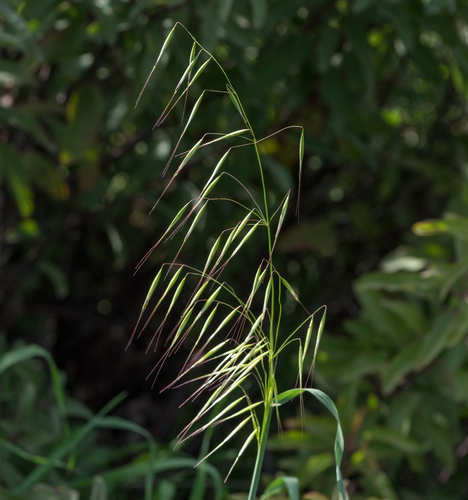
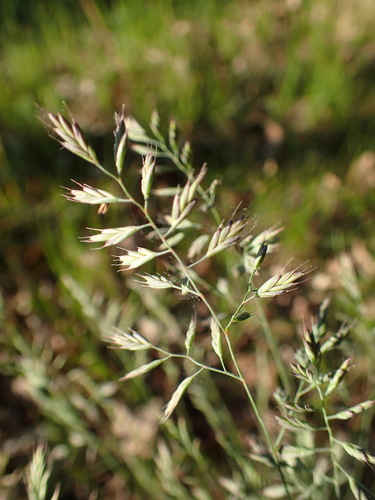
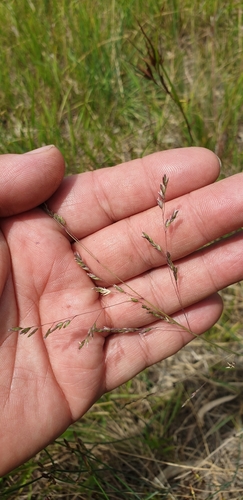
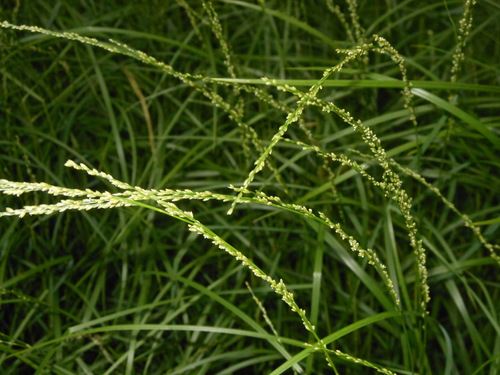
Glyceria melicaria (Michx.) F.T.Hubb. produces erect culms from a creeping base. There are one or few culms per plant, reaching heights of 0.6 to 1.2 meters (2 feet 0 inches to 3 feet 11 inches). Its leaf sheaths are smooth, and its ligules are translucent. The plant produces lax, elongated leaves that measure 25–40 cm (9.8–15.7 in) long and 2–7 mm (0.079–0.276 in) wide; leaves are smooth on the lower surface and scabrous on the upper surface. Its panicle is linear-cylindrical, 10–30 cm (3.9–11.8 in) long, and nods downward at the end. The closely appressed floral branches of the panicle hold 30 to over 60 spikelets per branch. The appressed spikelets are around 4 mm long, and each contains 3 to 4 flowers. Its glumes are lanceolate with acute apices: the lower glume measures 1.3–2.4 mm, and the upper glume measures 1.7–3 mm. Its lemmas have 5 to 7 veins, are 1.9–2.8 mm long, and the accompanying paleas are roughly the same size. This grass flowers from late June to August. Glyceria × gatineauensis is a sterile triploid hybrid between Glyceria striata and G. melicaria, recorded in Quebec and possibly present in West Virginia. The hybrid resembles G. melicaria, but has longer, less appressed panicle branches that can grow up to 12 cm (4.7 in) long. In terms of habitat and distribution, Glyceria melicaria grows in wet soils, swamps, and wet forests. Its range extends from New Brunswick to Ontario, south into Illinois and the northeastern United States, and continues south along the Appalachian Mountains as far as northern Georgia.