About Globularia salicina Lam.
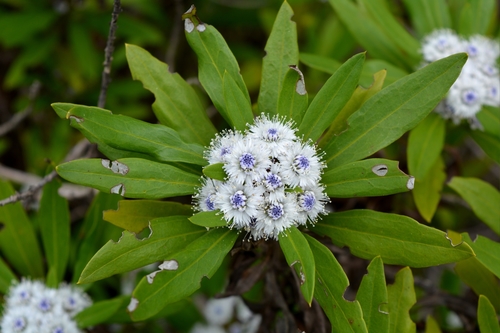
Globularia salicina Lam. is an upright evergreen shrub that grows up to 2 m tall, with slender branches. Its leaves measure 3.5–7 cm long by 0.5–3 cm wide; they are arranged alternately, shaped from narrowly to broadly lanceolate, have smooth entire margins, are hairless (glabrous), end in an acute tip, narrow to an attenuate base, and grow in an upright orientation. Its inflorescences form dense, globular flower heads, borne in axils with ovate bracts that range from covered in soft dense hair (tomentose) to becoming nearly hairless (glabrescent), and have densely long ciliate (hair-fringed) margins. The flower heads are usually less than 1.5 cm across, typically crowded toward the tips of stems, and are pale powder blue or whitish. Individual flowers are hermaphrodite and zygomorphic. The calyx is tubular, deeply divided into 5 linear lobes, with ciliate margins. The corolla is 4 mm long, with a slender tube and a 2-lipped structure: the upper lip is almost absent, while the lower lip has 3 long lobes. There are 4 exserted stamens, an exserted style, and a bilobed stigma. The fruit is a small 1-seeded nut that is 1 mm long and dark brown. This species is common in Madeira, where it grows on hillsides, cliffs, slopes, among rocks, and in rough grassland. In Madeira, it occurs mostly below 300 m elevation; it rarely grows above 400 m in northern Madeira, but can be found up to 700 m in southern Madeira. It is rare in Porto Santo, and is also recorded from Deserta Grande. It is rare on Gran Canaria, but common on southern slopes of Tenerife and in the northern coastal region of La Gomera. It also grows on El Hierro and in the north eastern region of La Palma.