About Gliophorus irrigatus (Pers.) A.M.Ainsw. & P.M.Kirk
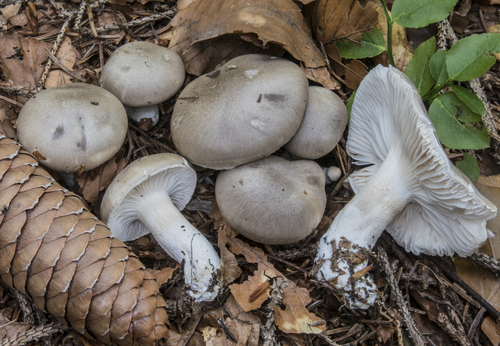
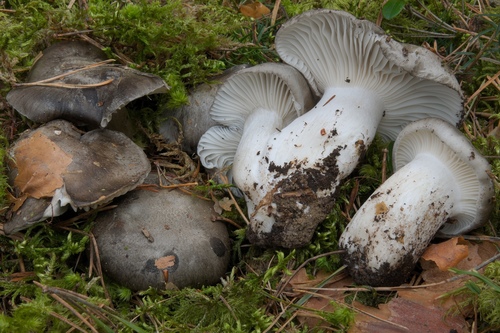
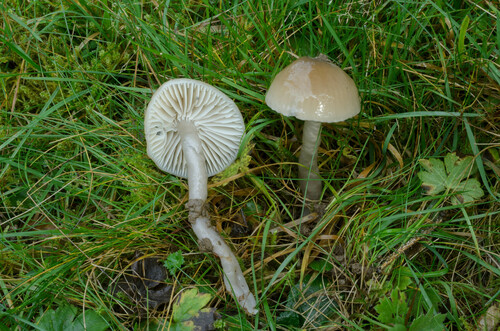
This species has the scientific name Gliophorus irrigatus (Pers.) A.M.Ainsw. & P.M.Kirk, and is commonly called the slimy waxcap. Its basidiocarps are agaricoid, growing up to 100 mm (4 in) tall. The cap is convex when young, and either stays convex or becomes flat as it expands, reaching up to 50 mm (2 in) across. When damp, the cap surface is very viscid, with striations at the margin, and it is pale greyish brown in color. The gills, also called lamellae, range from whitish to a pale shade matching the cap color, and are more or less decurrent, meaning they are widely attached to and run down the stem. The stipe, also called stem, is very viscid when damp, smooth, either cylindrical or compressed, and ranges from grey to a color matching the cap. The spore print of this species is white. Under a microscope, the spores are smooth, inamyloid, and ellipsoid, measuring approximately 6.5 to 8.0 μm by 4.5 to 5.0 μm. The recently described species Gliophorus alboviscidus is similar in appearance to Gliophorus irrigatus, but is entirely pallid to white. This fungus is distributed across Europe and the Caucasus, reaching as far east as Georgia. It was previously thought to grow in North America, but DNA sequencing has revealed that North American records of this species actually refer to several similar species: these include Gliophorus fumosus and G. parafumosus in eastern North America, and G. calunus and G. subaromaticus in western North America. Like most other European waxcaps, Gliophorus irrigatus grows in old, unimproved, short-sward grassland such as pastures and lawns. Recent research indicates that waxcaps are neither mycorrhizal nor saprotrophic, and may be associated with mosses.