About Glaucopsyche alexis (Poda, 1761)
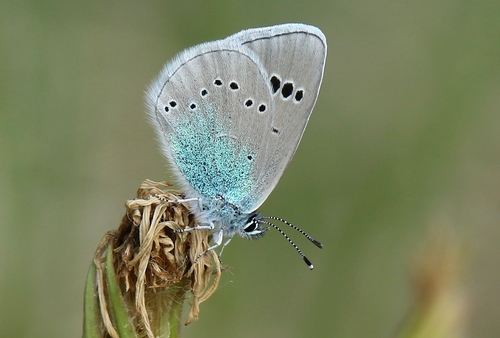
This entry is for Glaucopsyche alexis (Poda, 1761), cited as L. cyllarus Rott. (= damoetas Schiff.) from Seitz’s description. Males have light cyaneous blue upper wings with a violet sheen and a narrow black border; females are darker blue, with a black border that gradually fades and covers nearly the entire outer half of the wings. The underside is silver-grey in males and ashy grey in females. The forewing has 5 or 6 large rounded black spots, the hindwing has small ocelli, and the entire basal half of the hindwing is covered in metallic blue-green dusting. Several aberration forms of Glaucopsyche alexis are described. In ab. dimus Bgstr., the forewing underside ocelli are reduced to 4. Alternatively, these spots can increase in number or become elongated, which is the form subtus-radiata Oberth. In European Turkey and neighbouring areas of Anterior Asia, forewing ocelli are constantly or commonly enlarged and the blue is darker; this is ab. tristis Gerh. Ab. andereggii Ruhl is a large female form found in the Alps (and possibly elsewhere); its upper side is entirely black-brown, and its underside is dark ashy grey with very large ocelli that sit inside pale rings. Blachieri Mill. is a very small form from Southern France and Valais; it only has 4 forewing ocelli on the underside, very little blue-green dusting on the hindwing base, and darker, duller blue upper wings. Coelestina Mill., nec Ev. is similar to blachieri; it has very dull upper wing colour, blue-green scaling only on the basal half of the underside, reduced-sized forewing ocelli, and almost completely gone hindwing ocelli. Lugens Car. has completely lost all hindwing ocelli; males are darker blue on the upper side, and females are entirely black-brown, almost matching the female of semiargus with no blue at all. The blue-green scaling on the underside of the hindwing is completely or nearly completely absent. Two taxa previously listed as forms of this species are now treated as separate full species: Glaucopsyche aeruginosa (Staudinger, 1881) was originally aeruginosa Stgr., ranging from South Russia and Asia Minor, especially Lebanon, into Central Asia, and has blue-green dusting covering the entire underside of the hindwing. Glaucopsyche laetifica (Püngeler, 1898) was originally laetifica Pung. from the Ili River; it shares a similar underside with G. aeruginosa, but both sexes have purer, more brilliant blue on the upper wings, the antenna club is more elongated and reddish yellow on the inner side, so Püngeler already considered it likely a distinct species. The species ranges across Central and Southern Europe, North Africa, and North Asia as far as the Amur; it is not present in England or Japan. The larva is green or brownish, with a reddish brown dorsal line accompanied by closely spaced dark parallel oblique stripes, and has a black head. Larvae feed on Cytisus, Genista, Astragalus, Melilotus, and other plants, and can be found in June and autumn. The pupa is greyish brown. North of the Alps, where this species only produces one brood per year, the larva is thought to hibernate. Adults occur individually but are mostly common; they inhabit timber woodland clearings and wide roads, flying slowly in a straight flapping pattern usually 1 to 2 meters above the ground. In Southern regions, adults appear in spring and again from July onwards; in Northern regions they only have one flight period, at the end of May through June.