About Glaucomaria carpinea (L.) S.Y.Kondr., Lőkös & Farkas
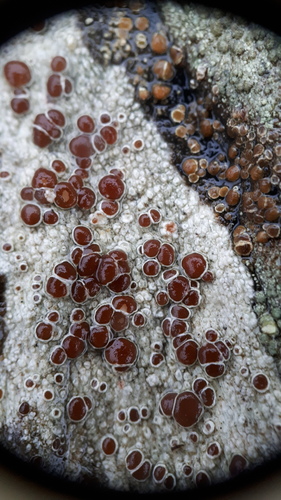
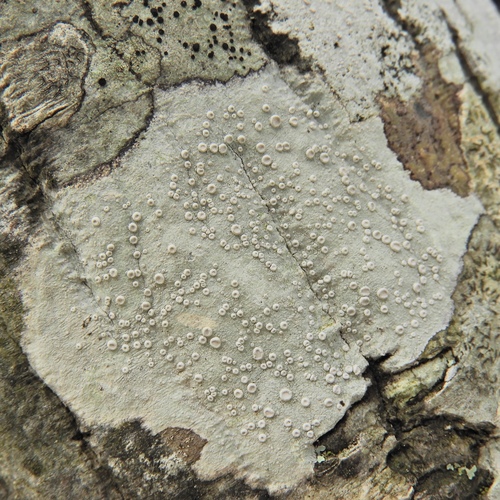
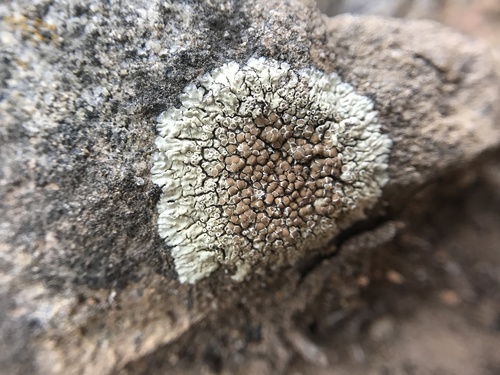
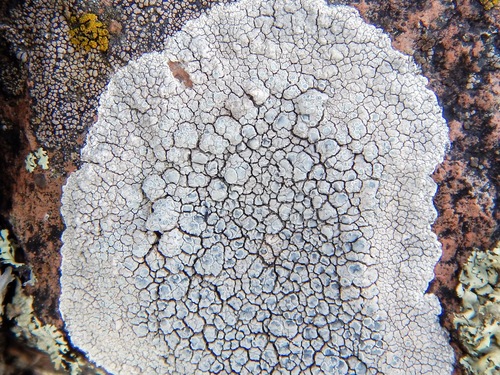
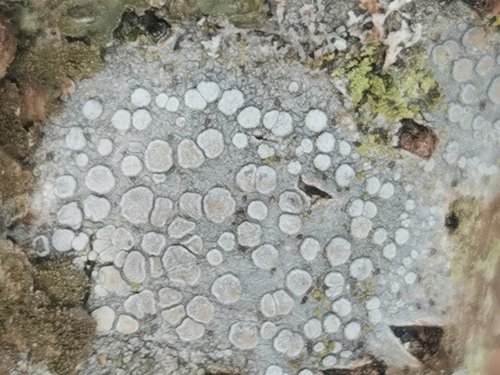
Glaucomaria carpinea is a lichen with a crustose (crust-like) thallus that may be continuous or cracked. The thallus ranges in colour from whitish to grey, has a smooth texture, and is epruinose (not covered in powdery material). A white prothallus (growth border) is sometimes present along the edges of the lichen. Its apothecia (fruiting bodies) are usually crowded together; they may be round or angular from mutual compression, and are either flat or slightly convex, measuring 0.5–1.5 mm across. The apothecial disc is orange-brown to flesh-coloured and is heavily covered in white pruina. The apothecial margin is thin, slightly prominent, and typically not wavy. The outer ring of the apothecia (the thalline exciple) has a well-developed cortex made of vertically aligned (anticlinally arranged) hyphae, with a medulla containing crystals that dissolve in potassium hydroxide (K) solution. The inner ring (the proper exciple) is thin and colourless, and also contains K-soluble crystals. The epithecium (the topmost layer of the apothecia) is pale brown and covered with a layer of fine crystals; both the pigment and crystals dissolve in K, producing a bright yellow colour change (C+ bright yellow). The hymenium (the spore-producing layer) is colourless, and 50–70 μm high. The paraphyses (sterile filaments inside the hymenium) are slightly thickened at their tips. The hypothecium, the layer below the hymenium, is colourless. The asci (spore-bearing cells) of this lichen are elongate-clavate (elongated club-shaped) and have very thin walls, with eight spores per ascus. The asci have a central tall structure called a tholus that stains blue when treated with iodine and potassium hydroxide (K/I+ blue), and this tholus is surrounded by a blue outer layer. The ascospores are single-celled, hyaline (translucent), simple, broadly ellipsoid, thin-walled, and measure 9–14.5 μm by 5–8.5 μm. The photosynthetic partner (photobiont) of Glaucomaria carpinea is chlorococcoid, a type of spherical green alga. Chemical spot testing of the thallus produces a yellow reaction to potassium hydroxide (K+ yellow). The main chemical compound in the thallus is atranorin, with smaller amounts of chloroatranorin and eugenitol. The pruina covering the apothecial disc contains sordidone as its major metabolite. Glaucomaria carpinea is a morphologically variable species, with variation most noticeable in how much pruina deposits on different structures and in the thickness of the apothecial margins. It is, however, consistently uniform in anatomy and chemistry. This lichen has an almost cosmopolitan distribution, and has been recorded in Africa, Asia, Europe, Macaronesia, New Zealand, and North America. It most commonly grows on the smooth bark of deciduous trees, particularly on twigs, branches, and young trunks.