About Glaucocharis pyrsophanes Meyrick, 1882
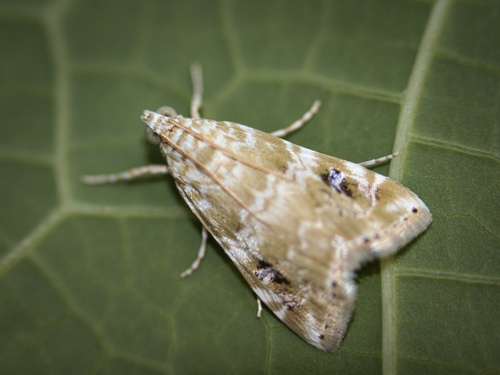
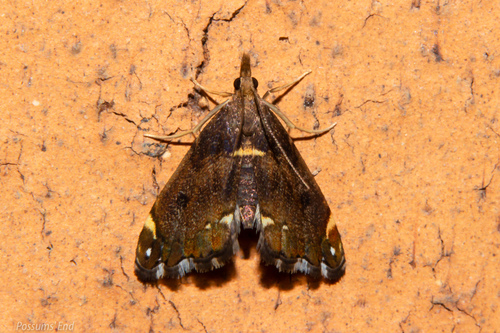
Meyrick originally described Glaucocharis pyrsophanes Meyrick, 1882 as follows: Both male and female individuals have a wingspan of 13+1⁄2 to 16 mm. The head is ochreous or brownish-ochreous. The palpi are light yellowish-ochreous, and are more brownish on their outer surface. The antennae are dark fuscous. The thorax is rather dark purplish-fuscous. The abdomen is dark purplish-fuscous, with a light yellowish ring near its base. The legs are clear whitish-ochreous. The forewings are triangular, very broad towards the posterior, with a very gently arched costa, rounded apex, oblique hindmargin, and moderately deep indentations. They are ochreous-brown, almost entirely suffused with dark purplish-fuscous except for a narrow section along the hindmargin, and broader sections at the apex and anal angle; they are also finely irrorated with grey, especially towards the costa and disc beyond the middle. There is a very small triangular yellow spot on the inner margin at 1⁄4, and an equally small, somewhat subquadrate yellow spot on the inner margin at 3⁄4, with a pale yellow dot positioned slightly above and beyond the apex of this spot. A very faintly visible darker transverse line runs from the costa at 1⁄4 to the first dorsal spot, and is sharply angled outwards beneath the costa. A suffused darker spot sits in the disc above and beyond the middle. A small, outwardly oblique triangular pale yellow spot is located on the costa at 3⁄4, and is sometimes closely preceded by a faint oblique yellowish costal mark. A very small suffused pale yellowish spot sits on the costa before the apex. A dark fuscous dot is present in the apex, preceded by a clear white dot; sometimes there is also a white dot on the hindmargin in the upper indentation. A slender dark fuscous hindmarginal line runs along the edge of the wing. The cilia are whitish ochreous, with a dark grey line near the base; they are entirely clear white on the indentations, and have a dark grey spot at the apex, another between the indentations, a third above the anal angle, and a fourth on the anal angle. The hindwings are fuscous-grey, with a very indistinct darker line towards the posterior, and a dark fuscous hindmarginal line. Their cilia are grey-whitish, with a grey line near the base. This species can be easily distinguished from other similar-looking species in its genus by its larger size and its distinct forewing pattern. Unlike G. planetopa, it does not have an oval silvery kidney-shaped patch on its forewings, and unlike G. microdora, it does not have a large yellow sigma-shaped marking on the first forewing line. G. pyrsophanes can also be told apart from G. microdora by the broad white bars on the cilia of its forewings, a feature G. microdora lacks. Hudson noted that this species varies in the intensity of its ground colour, and in the extent and number of its yellow markings. He observed that specimens from the South Island of New Zealand tend to be paler, with a more slaty hue on their forewings and smaller yellow markings. This species is endemic to New Zealand, where it is common and widely distributed across the country, including Stewart Island. G. pyrsophanes lives in lowland to subalpine native forest, and can be common in forest openings, especially damp, sunny openings. Larvae of all Glaucocharis species feed on mosses and liverworts. Adult moths of this species are known to feed from and pollinate Leptospermum scoparium and Helichrysum selago.