About Glaucocharis leucoxantha Meyrick, 1882
Meyrick's original description of Glaucocharis leucoxantha Meyrick, 1882 focuses on the female, which has a 19 mm wingspan. The head and thorax are light orange-ochreous. The palpi are ochreous-orange, with their base, apex, and upper surface mixed with dark fuscous. Antennae are whitish-ochreous. The abdomen is ochreous-whitish, suffused with grey towards its posterior end. Legs are whitish-ochreous.
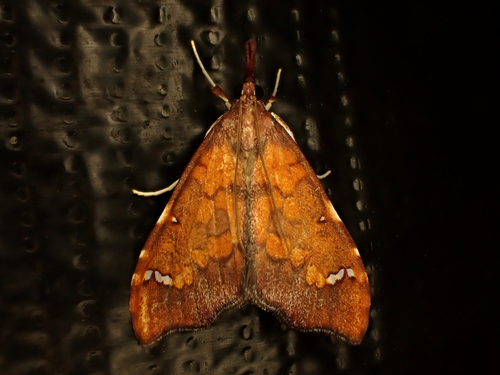
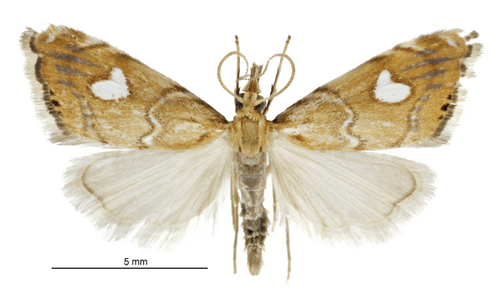
Forewings are triangular, very broad posteriorly, with a very gently arched costa, rounded apex, and oblique hindmargin with moderate sinuations. Their base colour is light ochreous-orange, deepening to a darker orange towards the posterior region, especially near the apex. The transverse lines are mostly obsolete; only the second line is faintly visible, being slightly darker, sinuate, curved outwards, and extending from ¾ of the costa to ⅘ of the inner margin. Beyond the middle of the disc lies a comparatively large, oval, snow-white spot, which is suffusedly margined with dark fuscous, with its anterior end extended upwards into a blunt tooth. A transverse series of eight very short, slender, longitudinal leaden-metallic streaks sits along the second line; the second and third streaks from the costa are considerably longer than the remaining ones. The forewing cilia are ochreous-white, with a dark grey spot at the apex, another dark grey spot at the anal angle, and a deep grey brassy-metallic basal line.
Hindwings are white, with a faint yellowish tinge towards the hindmargin; their cilia are white. The forewing colouration of this species is extremely variable.
This species looks similar to Glaucocharis lepidella, but is smaller in size, and the crescent-shaped spot on its forewings is white or yellow, rather than silver as seen in G. lepidella. Gaskin noted that silvery veins in the subterminal region of the forewing are also a diagnostic feature of G. leucoxantha.
This species is endemic to New Zealand, where it occurs on the North Island, South Island, and Stewart Island/Rakiura, at altitudes ranging from lowland to subalpine. It inhabits native forest. Hudson recorded observing this species in native beech forests of the South Island, at elevations between 1,500 and 2,500 feet above sea level. Larvae of all Glaucocharis species feed on mosses and liverworts.