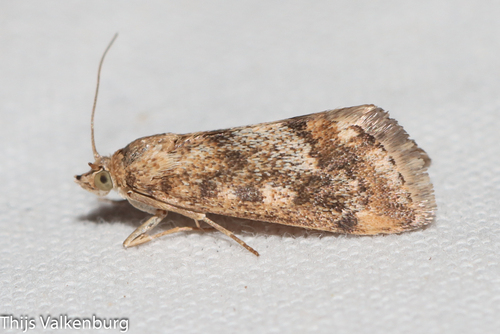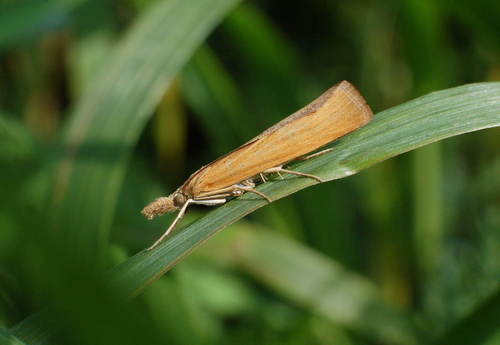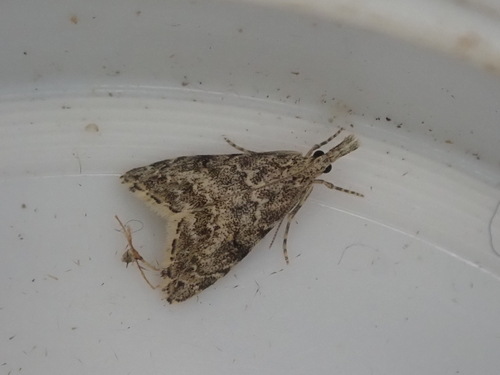
About Glaucocharis elaina Meyrick, 1882
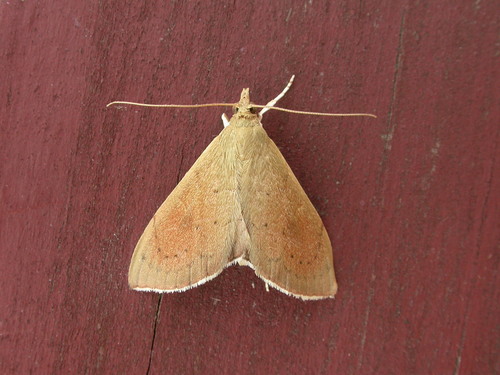
Glaucocharis elaina Meyrick, 1882 has the following documented morphological characteristics. Gaskin described the species' egg as a flattened ovoid shape with no ribs, a microscopic hexagonal pattern on the shell, and dimensions of 0.32-0.34 × 0.19-0.20 mm. Gaskin also described the fully grown larva: it reaches about three-quarters of an inch in length, is greyish in colour, has an irregular reddish line running down its back, and bears some black and whitish marks. Hudson described the adult: the wing expansion is slightly over 1⁄2 inch. The fore-wings are pale grey with a slight ochreous tinge, finely speckled with blackish (especially near the base and termen), and the space between the two transverse lines is usually paler; there is an elongate black spot slightly above the middle of the wing. The hind-wings are pale grey. Hudson notes that the moth's grey colouration is protective, helping it camouflage against lichen-covered rocks or tree trunks. This species is very similar in appearance to Glaucocharis parorma, and the two species have often been confused in collections. However, G. parorma has a series of black terminal dots on its forewing that G. elaina lacks, so this characteristic can be used to distinguish the two species. This species is endemic to New Zealand, and is found throughout the country except in the extreme south of the South Island. Adult moths inhabit lowland native forest, and are often found near broken ground. They have been observed in large numbers at road or rail cuttings adjacent to native forest or bush. The larvae feed on mosses, including species in the genus Funaria. Both Hudson and Gaskin agreed that this species has two distinct broods. Eggs are laid in patches from early to late summer, on moss. Gaskin hypothesised that the species spends the winter months as a pupa. Larvae create their pupa in a chamber within the moss that they feed on. Adult G. elaina are on the wing from October until April; they are nocturnal and attracted to light.