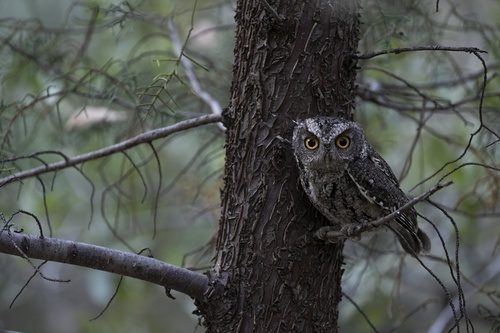
About Glaucidium radiatum (Tickell, 1833)
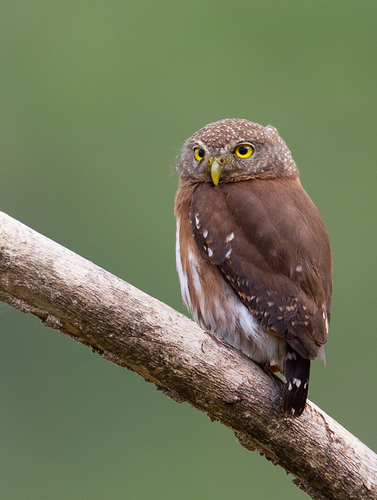
This small owlet, Glaucidium radiatum, has a rounded head and fine barring across its entire body. It lacks a distinct facial disk; its wings are brownish, and its tail is marked with narrow white bars. Two subspecies are currently recognized. The nominate subspecies occurs in the plains of India and Sri Lanka, while G. r. malabaricum from the Western Ghats has a shorter tail and more brown coloration on its head. It has been proposed that G. r. malabaricum may deserve to be classified as a full separate species. The upperparts plumage is dark black-brown with white barring. The wing coverts have white and rufous patches. The primaries and secondaries are dark brown with pale chestnut barring. The underparts are whitish or pale rufous with black barring. There is a distinct whitish patch on the chin, upper breast, and center of the abdomen. Its iris is yellow; the bill and tarsi are greenish, and it has black claws. The chestnut-backed owlet, Glaucidium castanonotum, was once included as a subspecies of G. radiatum but is now recognized as its own full species. G. castanonotum is found in Sri Lanka's wet zone, while G. radiatum occupies drier Sri Lankan forests. This species occurs across a range of forest habitats, from scrub forest to deciduous and moist deciduous forests. Its distribution covers areas south of the Himalayas, with populations extending into parts of the Himalayas up to 2,000 meters (6,600 feet) in elevation. Its range stretches from Dalhousie in the west eastward to Bhutan. Glaucidium radiatum is primarily active at dawn and dusk, though it is also known to call and fly during daylight. Its distinctive call is a rapid series of notes that increase in volume, then fade before ending abruptly. During the day when roosting, these owlets are often mobbed by drongos, treepies, and sunbirds. Young nestlings produce tick-like calls during the day that resemble the calls of pale-billed flowerpeckers. Jungle owlets roost inside tree cavities. When disturbed, they freeze and take on an appearance matching a dead tree stump. They sometimes perch openly on wires or bask in morning sun before returning to their roost. They have been recorded capturing small Phylloscopus warblers during the day, although their peak foraging activity falls within the hour before sunrise and the hour after sunset. Their diet includes insects, small birds, reptiles, and rodents. In India, the breeding season runs from March to May. They nest inside tree hollows located 3 to 5 meters (10 to 16 feet) above the ground. The typical clutch size is four eggs for the nominate subspecies, while G. r. malabaricum usually lays a clutch of three eggs.