About Glaucidium peruanum C.König, 1991
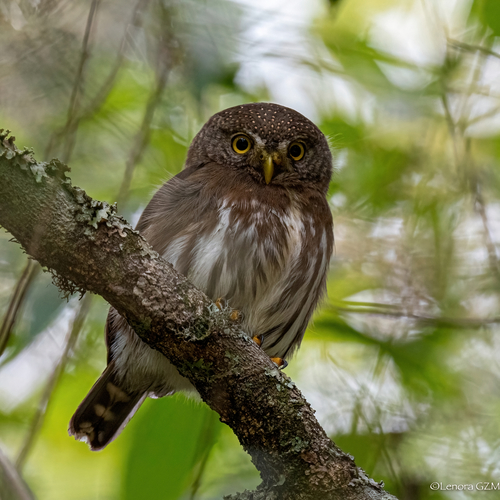
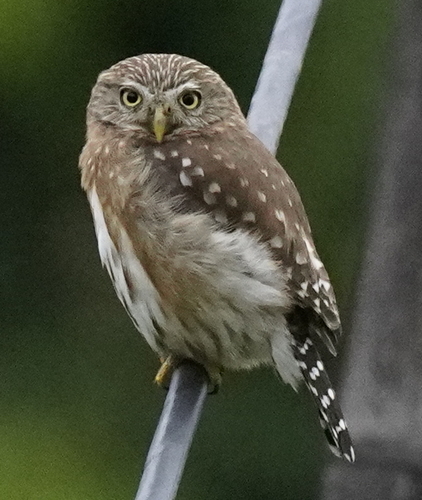
The Pacific pygmy owl (Glaucidium peruanum) measures 15 to 17 cm (5.9 to 6.7 in) in total length. Males weigh approximately 60 g (2.1 oz), while females weigh around 65 g (2.3 oz). Beyond being heavier, females also have slightly longer wings and tails than males, but both sexes share identical plumage patterns. This species has three distinct color morphs: gray, brown, and rufous, with the gray and brown morphs being the most common. For adult gray morph individuals, upperparts are grayish brown, with buff streaks on the forecrown and buff spots across the crown and nape. An incomplete white collar and oval black spots on the neck create the false appearance of extra eyes. The shoulders and back bear whitish spots, and the grayish brown tail has up to seven whitish cross bars. The throat is white, the sides of the breast are grayish brown, and the remaining underparts are whitish with rufous streaks. The brown and rufous morphs replace the grayish brown base color with dark brown or rufous respectively. In the rufous morph, tail bars are rusty brown or orange-buff, and underpart streaking is more diffuse than in the other two morphs. Across all morphs, the eyes are lemon yellow, and the bill and feet are yellow-green. Juveniles have plumage that is almost identical to adults, but lack any streaks or spots on the crown. This owl is distributed along the western slope of the Andes, ranging from the north-central Ecuadorian provinces of Manabí, Pichincha, and Los Ríos, south through Peru into Chile’s Antofagasta Region. It also occurs in several semiarid valleys within the western Andes. In Ecuador, it most commonly occurs from sea level up to 1,200 m (3,900 ft), but can be found locally as high as 2,400 m (7,900 ft). In Peru, it occurs up to 3,300 m (10,800 ft), and in Chile up to 3,500 m (11,500 ft). It inhabits a range of moist to arid environments, including deciduous and riparian forest, arid lowland and montane scrublands, agricultural areas with large trees, and gardens in developed areas.