About Glaucidium perlatum (Vieillot, 1817)
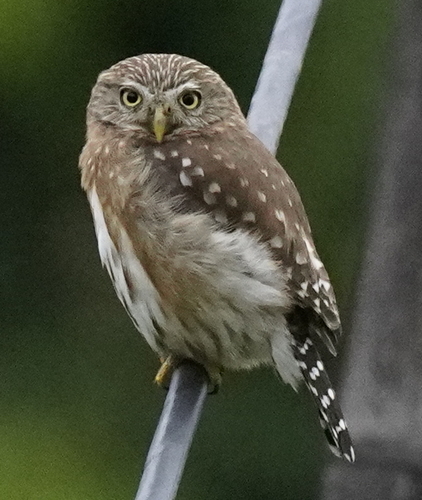
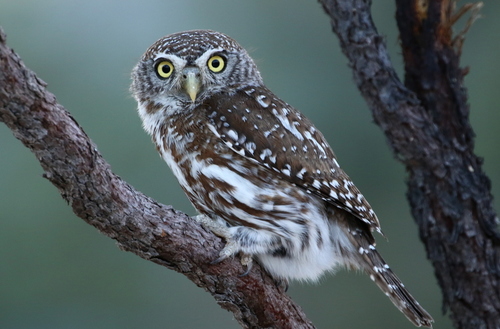
The pearl-spotted owlet, with the scientific name Glaucidium perlatum (Vieillot, 1817), is one of the smallest owls in Africa. It measures 17 to 21 cm in total length. Females are slightly larger and heavier than males, averaging 100g compared to the male average of 65g. Males and females have similar plumage coloration. They have an off-white facial disc and yellow eyes. Two striking false black 'eyes' outlined in white appear on the back of the head. Upperparts are cinnamon-brown marked with white spots. The tail and flight feathers are brown, with large white spots that form bars when the bird is in flight. The bill and cere are pale greenish yellow, the legs are feathered white, and the feet are yellow. Juveniles resemble adults, but may lack or have greatly reduced spots on the head and back, and their false 'face' marking is very obvious. Pearl-spotted owlets are often confused with African barred owlets. African barred owlets differ by having finely barred rather than spotted heads and backs, a blotched rather than streaked breast, barring across the upper breast, no false 'eyes' on the back of the head, and a proportionally larger head. The pearl-spotted owlet occurs across sub-Saharan Africa, and is particularly widespread in African savanna. Its range extends across northern and central Namibia, south to the southern limit of arid bushveld and woodland in southern Namibia. The species' range continues further north through Botswana and Zimbabwe, reaching as far north as Sudan, and as far west as Senegal. It occupies a wide range of woodland and bushveld habitats, especially mopane woodland and open thorn savanna with areas of sparse ground cover. It avoids dense woodland and forest, as well as open grassland and shrubland. Currently, three subspecies are recognised across Africa: Glaucidium perlatum perlatum, found from Senegal and Gambia to western Sudan; Glaucidium perlatum licua (Lichtenstein, 1842), found from Eastern Sudan and Ethiopia to northern South Africa, Angola and Namibia; and Glaucidium perlatum diurnum (Clancey, 1968), found in Namibia, Botswana, Zimbabwe, and Mozambique. The pearl-spotted owlet has an extremely large range, so it does not approach the thresholds for Vulnerable under the IUCN range size criterion. Its population trend appears to be stable. While the total population size has not been quantified, it is not believed to be of conservation concern. For these reasons, the pearl-spotted owlet is evaluated as Least Concern on the IUCN Red List. Pearl-spotted owlets hunt mostly at night from a low perch, taking prey from the ground below, but sometimes swoop to snatch prey from foliage, off nests, or in flight. They also hunt opportunistically during the day, and are often mobbed by small birds when active in daylight. When excited while hunting, they flick their tail feathers or bob their head up and down. They predominantly eat arthropods, especially grasshoppers, crickets, and solifuges, but are capable of hunting small vertebrates such as rodents, bats, lizards, snakes, and small birds. Although the pearl-spotted owlet is not a threat to larger vertebrates, the capture and killing of pearl-spotted owlets by Red colobus in western Uganda has been observed, as an anti-predator behaviour.