About Glaucidium passerinum (Linnaeus, 1758)
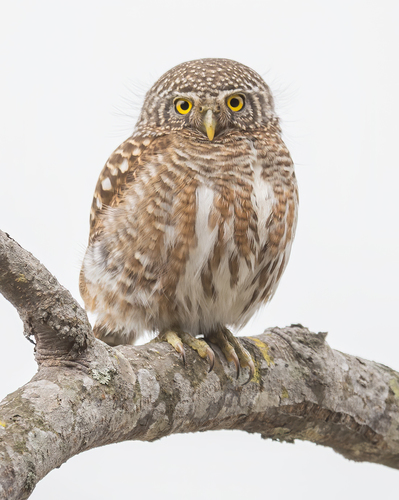
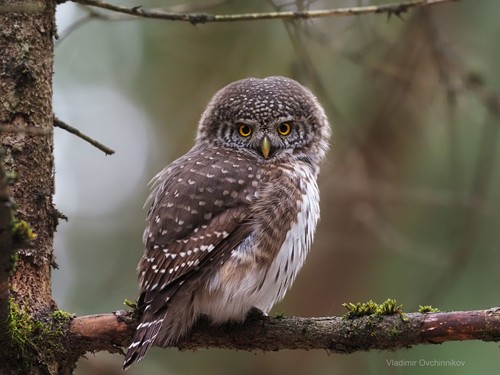
The Eurasian pygmy owl (Glaucidium passerinum (Linnaeus, 1758)) typically has plumage ranging from red-tinged to greyish-brown, with spots covering its back. Its tail is usually darker than its body, marked with five narrow whitish bars. It has a small, short head with white to grey eyebrows and yellow eyes, and lacks the ear tufts found in many other owl species. A white half-collar is present on the back of its neck. Its belly is mostly white with brown speckles. The beak is greyish-yellow and hook-shaped. To help it carry larger vertebrate prey, this species has evolved disproportionately large feet. Its legs and toes are brownish-yellow, ending in black talons. Females measure 17.4 to 19 cm (6.9 to 7.5 in) in length, while males are generally smaller, at 15.2 to 17 cm (6.0 to 6.7 in) long. Female body weight ranges from 67 to 77 g (2.4 to 2.7 oz), and male body weight ranges from 50 to 65 g (1.8 to 2.3 oz).
This owl is found primarily in the coniferous forests of the taiga, and in higher mountainous regions that contain coniferous and mixed forests. These areas are generally cooler and receive more rainfall than nearby lowland regions. The Eurasian pygmy owl usually inhabits the edges of clearings bordered by moist or swampy land, and typically stays near a water source. It nests in old woodpecker holes, most often those made by the great spotted woodpecker.
This is a crepuscular owl, active during daylight hours near sunrise and sunset. Its diet consists mostly of small mammals including voles, lemmings, bats, and mice, and small birds including thrushes, crossbills, chaffinches, and leaf-warblers. It is capable of catching birds in flight. Additional prey items can include lizards, fish, and insects. Pygmy owls store large amounts of small mammals and birds in food stores they collect in autumn, which they use to supplement their diet through the winter. Their food hoarding behavior is strongly influenced by weather conditions, which makes them vulnerable to climatic changes.