About Glaucidium nana (P.P.King, 1827)
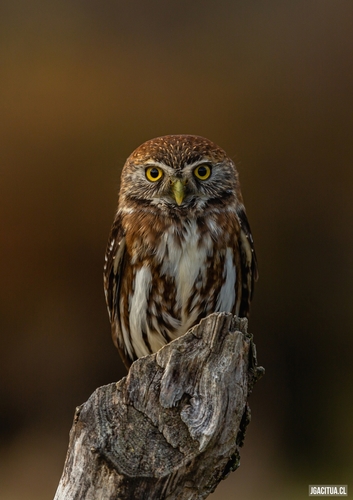
This species, commonly known as the austral pygmy owl, has the scientific name Glaucidium nana (P.P.King, 1827). The austral pygmy owl measures 17 to 21 cm (6.7 to 8.3 in) in total length. Males weigh between 56 to 75 g (2.0 to 2.6 oz), while females are heavier, ranging from 70 to 100 g (2.5 to 3.5 oz). This species displays two distinct color morphs: gray-brown and red, as well as intergraded individuals between the two morphs. Adult owls of both morphs share common facial features: a pale grayish brown face marked with dark flecks, whitish eyebrow-like markings over pale yellow eyes, and characteristic black "false eye" spots on the back of the nape. For the gray-brown morph, the upperparts are dark grayish brown with whitish dots that vary in both size and shape. The tail is also dark grayish brown, marked with narrow buffy bars. The throat of this morph is white, the sides of the upper breast are dark grayish brown, and the underparts are off-white streaked with dark grayish brown. The red morph follows the same overall pattern, but all dark grayish brown areas are replaced with reddish brown instead. The austral pygmy owl is distributed from approximately Valparaíso Province in Chile and Neuquén Province in western Argentina, extending south all the way to the southern tip of Tierra del Fuego. In Chile, its elevational range spans from sea level up to 2,000 m (6,600 ft). It occupies a wide variety of habitats, including city parks, farmland with scattered trees, deciduous forests and thickets, evergreen shrublands, temperate and southern beech (Nothofagus) forests, and Patagonian scrub/steppe.