About Glaucidium cuculoides (Vigors, 1831)
The Asian barred owlet (scientific name Glaucidium cuculoides (Vigors, 1831)) is a small owl, with adult body length measuring 22–25 cm (8.7–9.8 in). Males weigh 150–176 g (0.331–0.388 lb), while females can reach up to 240 g (0.53 lb). Like most species in the true owl family, female Asian barred owlets are typically larger than males.
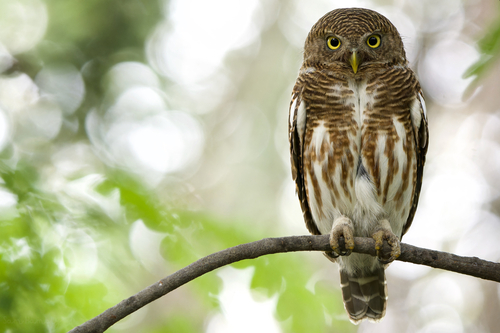
Adult Asian barred owlets have dark brown or olive-brown plumage that is densely barred, with a distinct white throat patch. Their breast and belly are whitish with dark brown bars, and their tail and wings are dark brown with whitish bars. Unlike other pygmy owl species, they do not have false eye markings on the back of the head. Juveniles have a streaked rather than barred breast, and their head is a more ruddy brown. This species is similar in appearance to the Javan owlet and the collared owlet.
Asian barred owlets are mainly diurnal, perching on bare branches to hunt freely during the day. Because they are active in daylight, they are often mobbed by smaller birds, and they remain still while being mobbed. Like other owlets, they have an undulating flight pattern: a sequence of rapid flaps followed by a pause with their wings closed.
Asian barred owlets most commonly inhabit woodland areas, including pine and oak forests, and subtropical and tropical evergreen jungles at lower elevations. They also occur from foothills to submontane regions up to 2,100 m (6,900 ft) in elevation; the highest recorded sighting of the species was at 2,700 m (8,900 ft) in the Himalayas of northern Pakistan. They sometimes also live near developed areas, in gardens and parks. Across parts of their range, Asian barred owlets prefer secondary forests over primary forests.
The species is widespread across mainland Southeast Asia. Its distribution includes southeast China, Bhutan, Myanmar, Laos, Vietnam, Thailand, Nepal, Bangladesh, northeast India, and the Himalayan foothills extending into Pakistan.
The breeding season of Asian barred owlets runs from January to February in Thailand, and from March to June across most other parts of the species' range. They nest in unlined tree cavities and old nests originally built by woodpeckers and barbets. They may also use old nest cavities from collared scops owls (Otus lettia) in areas where the two species share habitat. Asian barred owlets have even been recorded killing woodpeckers or barbets to take over a nest hole. In 2017, a small number of ground nests were observed in Thailand; researchers suggest this may have occurred because no suitable tree nest sites were available in the area.
A breeding pair produces one clutch per year, containing 3 to 5 white, rounded eggs. After hatching, both parents care for the young and bring food to the nest. Chicks fledge as early as April in Thailand, and fledge by early July across most of the species' range.