About Geum urbanum L.
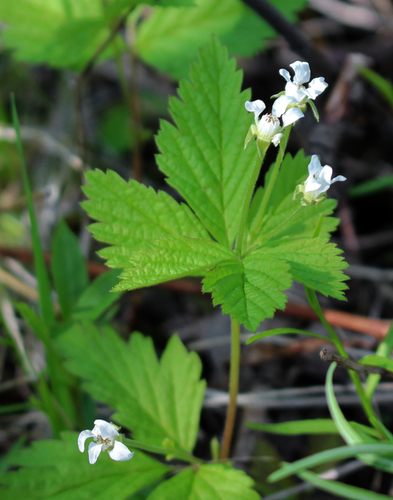
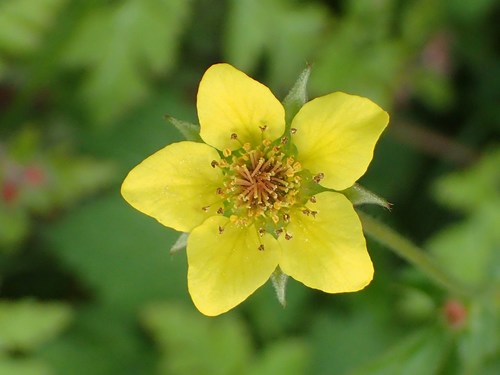
Geum urbanum L. is a downy perennial herb with a short, thick rhizome that is purple in cross-section, and thin, wiry stems that grow up to 60 centimetres (24 in) tall. Its leaves vary greatly in form based on their position and local growth conditions, and they are pinnate. They have 2–3 pairs of unequal lateral leaflets 5–10 millimetres (1⁄4–3⁄8 in) long, plus one large, terminal three-lobed leaflet with a base ranging from cuneate to cordate. Upper stem leaves are either trifoliate with three long, narrow leaflets, or undivided. Its stipules measure 4 x 3 cm, and are as wide as they are long. This plant blooms between May and August, but its flowers can persist into autumn, and sometimes as late as December. The flowers are 1–2 cm in diameter, with five bright yellow petals clearly separated from a calyx split into 5 large and 5 small segments. These hermaphrodite flowers are relatively small for the size of the plant, they are scented, and they are pollinated by bees. The fruiting head is made up of many zigzag-shaped hairy achenes 5–10 mm long. When in fruit, the lower part of each achene’s style forms a burr that can hook onto the fur of rabbits and other animals to aid seed dispersal. Geum urbanum is found across most of Europe: its distribution is more scattered in southern Iberia and Russia, and it is entirely absent from northern Scandinavia, Iceland, the Faroe Islands, Shetland, Malta, the Balearic Islands, and the Aegean Islands. It also grows in the Atlas Mountains of Morocco, Algeria, and Tunisia, in Turkey, the Levant, the Caucasus, and the Armenian Highlands, around the Alborz mountains in Iran, and grows less extensively in western Siberia and the mountains of Central Asia as far east as the Western Himalayas. G. urbanum is a common, typically lowland plant that prefers dry semi-natural broadleaved woodland, scrub, hedgerows, and waysides on well-drained soils. It sometimes also grows in open, disturbed habitats with nitrogen-rich soil, and can occur as a garden weed. It grows on mildly acidic to calcareous soils with a pH range of 5.4–7.7. It has moderate shade tolerance, and is absent from open grassland communities, where it appears unable to compete with other plant species. Its short rhizomes support the growth of flowering stems, and can maintain potentially viable axillary buds for several years after the buds form. This plant is usually sparsely distributed across its habitat, because new plants mostly grow from scattered propagules, and vegetative spread is relatively rare. Some of its basal rosette leaves grow in October, overwinter in a vegetative state, and remain green and photosynthetically active through the winter. G. urbanum grows in a range of woodland and scrub communities, including the Fraxinus excelsior – Acer campestris – Mercurialis perennis – Glechoma hederacea subcommunity (W8) on base-rich soils, and the F. excelsior – Sorbus aucuparia – M. perennis community (W9) in the cooler, wetter northwest of Britain. It occasionally grows in Alnus glutinosa – Urtica dioica woodland (W6), and is widespread but local in Rubus fruticosus – Holcus lanatus scrub (W24). This species can be infected by multiple fungal pathogens, including downy mildew species in the genus Peronospora, the powdery mildew Podosphaera aphanis sensu lato, and Ramularia species. Ramularia infection causes pale spots to form on the plant’s leaves. Its leaves can be cooked and eaten like spinach. Its roots contain the compound eugenol, which is also found in cloves, and are used as a spice in soups and to flavour ale. For example, Augsburg Ale is said to get its distinctive flavour from placing a small bag of avens inside each cask. Fresh root gives the liquor a pleasant clove-like flavour, prevents it from souring, and is said to add wholesome properties. Herbalists have used wood avens to treat various diseases, but there is no evidence that it provides any medical benefit. A cordial used against the plague was historically made by boiling the roots in wine. English botanist John Gerard recommended a wine-based decoction of the roots to treat stomach issues and bites of venomous beasts. Due to its purported digestive tonic properties, chewing the root was also recommended to treat foul breath.