About Geum triflorum Pursh
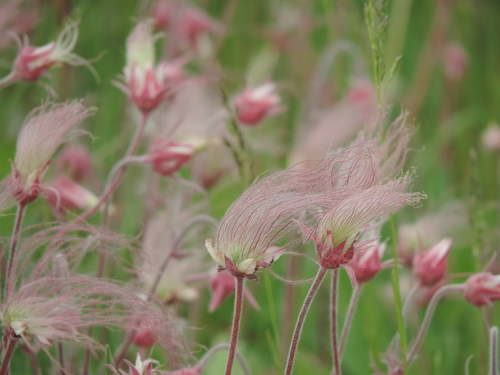
Geum triflorum Pursh, also called prairie smoke or three-flowered avens, is a perennial herb that grows from short, spreading rhizomes, forming colonies of stemless leaf rosettes. Its roots are fibrous and have a sassafras-like flavor. Leaves grow from a caudex, reaching 4–30 cm (1.6–12 in) in length. They are divided into deeply cut leaflets that give the leaves a fern-like appearance. Leaflets are arranged pinnately along a central leaf stalk, with 7–18 larger leaflets mixed with smaller ones, and one larger leaflet at the tip of the leaf. All leaf surfaces are covered in very fine, downy hairs. Early in spring, new leaves often lie flat against the ground and look poor, but they become more upright as temperatures warm and snow melts. During hot, dry summer weather, leaves will lie flat against the ground again. Plants resume new growth in autumn, when other plants are entering dormancy, and form a mound of deep grey-green leaves. In regions without extreme cold, or where snow provides insulation, leaves are evergreen, and often turn shades of purple, orange, or red. Flowers develop from mid-spring to early summer. Flower stalks grow well above the leaf mound, reaching 10–45 cm (3.9–18 in) in height, and are colored red-purple to maroon. The flowering stem is nearly leafless, with only a few very small bractlets on the main stem and at the points where arching individual flower stalks (pedicels) attach to the main stem. Each flower hangs upside down from its own pedicel. Most stalks produce three flowers, but counts of one, five, or even seven flowers per stalk are sometimes seen. The sepals are tightly closed, pink to maroon, covered in fine downy hairs, and have five narrow pointed bracts that radiate outward toward the base of the flower. Each flower has five elliptical petals 7–13 mm long, which are mostly or entirely hidden by the closed sepals. Petals are most often pale yellow to cream, sometimes with a pink or purple blush, and have visible purple veins. After pollination is complete, the flower head turns upright and the sepals begin to open, which may make the petals visible. The many styles grow longer, eventually reaching 15–70 mm in length. Styles are densely covered in fine hairs, giving them a resemblance to soft bird feathers or wispy mauve smoke. Immature seed heads are pale pink, and fade to tan or grey as seeds ripen in mid-summer. Tests show that seeds do not require cold stratification, as germination rates did not change significantly when this treatment was applied. G. triflorum is widespread across North America, but is only common in the Upper Midwest and mountainous western regions. In Canada, it is common from British Columbia to Manitoba, and also grows in parts of Yukon Territory and Northwest Territory. It is a common prairie species in Minnesota, Wisconsin, and North Dakota. Adjacent to this main range, it has been reported from nine northeastern counties in Illinois and eight northeastern counties in South Dakota. The USDA PLANTS database records it growing in Iowa, but does not note a specific location there. It is common throughout the prairies of Montana and Wyoming, and extends into the mountains of Idaho, Colorado, Utah, and Nevada. It grows in the Black Hills of South Dakota, eastern Washington, eastern Oregon, and the northeastern mountain region of California. Populations also occur in the mountains of northern New Mexico and Arizona. Populations in eastern North America and Ontario are much rarer and isolated. It grows in six counties of Michigan’s lower peninsula, and only Chippewa County in Michigan’s upper peninsula. In New York state, the USDA PLANTS database only records it growing in Jefferson County and Oswego County, which border Lake Ontario; the New York Flora Atlas only lists vouchered specimens from Jefferson County. G. triflorum grows in open, non-forested habitat with well-drained soils. Typical habitats include montane meadows, Upper Midwest prairies, and alvars in Michigan, New York, Ontario, and Manitoba. The species tolerates clay soils when slopes provide sufficient drainage, but cannot tolerate waterlogging, especially over winter. New plants require good moisture to establish, and prefer sites with ample spring water, but tolerate summer drought and grow healthier in drier summer soils. In wetter regions, it is most often found on freely draining soils or raised areas above the surrounding landscape. In drier regions, it typically grows in lower areas that collect extra moisture from spring runoff. Prairie smoke tolerates light shade, and prefers some afternoon shade in regions with hot summers. In the central Rocky Mountains, it grows up to the timberline at 3,800 meters (12,500 ft), and grows as low as 2,000 meters (6,600 ft) in the foothills. In New York, it grows at 90 meters (300 ft) in elevation, and in the Midwest it grows near Great Lakes level at 90 meters at Chaumont Barrens Preserve. G. triflorum flowers produce both nectar and pollen. They are commonly visited by bumblebees, which can force their way into the mostly closed flowers to reach nectar. Bumblebees also use buzz-pollination to dislodge pollen from stamens to collect for their young. Since G. triflorum blooms early in the season and produces large quantities of flowers in suitable habitat, it is thought to be a critical plant for queen bumblebees establishing their first broods. Smaller bees such as sweat bees in the genus Lasioglossum feed on pollen grains from the small opening of the closed flower. Bumblebees are the only effective cross-pollinators for G. triflorum, which, like tomatoes, depends on buzz pollination. Various insects act as nectar robbers by chewing holes in the top of the flower near the stem to access nectar. It is not a major forage source for most native herbivores, including mule deer, elk, pronghorn, and game birds, but is eaten by white-tailed deer. It is also not generally eaten by cattle, horses, or domestic sheep, and has a low protein content. Prairie smoke is planted as an ornamental garden plant, valued for its distinctive seed heads and persistent winter foliage. It is popular for native gardens, rock gardens, and for gardeners seeking an informal natural look. It is also suitable for green roof plantings due to its tolerance of extended drought. Plants are winter hardy in USDA zones 3–7 and have no major serious disease or pest issues. It can be planted in spring or fall from nursery-grown plants or seed. Mature plant size depends on soil richness: very lean, low-organic soils produce compact plants, while rich soils produce larger, more competitive plants. It cannot tolerate deep shade, and may be outcompeted and displaced by taller species that grow over it and block sunlight. Some Indigenous peoples of the Northwest Plateau used three-flowered avens to treat tuberculosis. As recorded by Walter McClintock and later John C. Hellson, people of the Blackfeet Nation made an infusion of the roots to treat sore throats and mouth canker sores, and applied the infusion to wounds. They also mixed this root infusion with grease to make a salve for treating rashes, blisters, sores, and wounds. Infusions of the whole plant were used to treat severe coughs. Blackfeet people scraped the roots of G. triflorum, mixed them with tobacco, and smoked the mixture to "clear the head". They also drank a tea made from the whole plant to support general health.