About Geum rivale L.
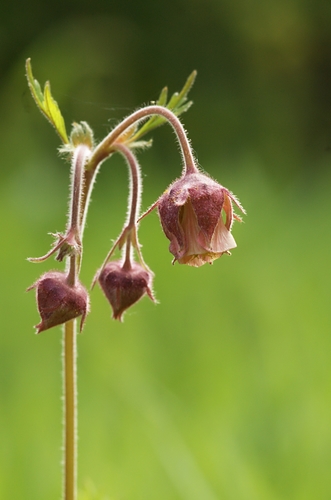
Geum rivale, commonly called water avens, is a flowering plant species in the genus Geum of the family Rosaceae. Its other common names include nodding avens, drooping avens, cure-all, water flower and Indian chocolate; in parts of its native range it is also known as purple avens. This species is native to temperate regions of Europe, Central Asia, and parts of North America. It grows in bogs and damp meadows, and produces nodding red flowers from May to September. Geum rivale is widespread across Europe, especially in northern and central areas. It occurs throughout the British Isles, the Faroes, Iceland, Scandinavia, the Baltic States, and most of Central Europe, reaching elevations of up to 2400 m in the Alps and 2100 m in the Carpathians. It is not found in the Pannonian Basin or western France. On the Italian Peninsula, it grows only in scattered locations in the northern and central Apennines. On the Iberian Peninsula, it is restricted to elevations between 1000 m and 2200 m in the Cantabrians, Pyrenees, the Iberian and Central Systems, and the mountain ranges of Sierra Nevada and Sierra de Cazorla in southern Iberia. It also grows in the mountains of the Balkan Peninsula, where in Bulgaria its altitudinal range is 1200–2100 m, as well as the Caucasus, northern Anatolia, and north-western Iran. It is also native to northern Ukraine, central and northern European Russia, Western Siberia east to the Sayan–Angara region, and parts of Central Asia, including the Dzungaria, Tarbagatai, and Tian Shan areas. It is native to a broad region spanning Canada and the United States. Geum rivale is a native perennial that grows in slow-draining or wet soils, and tolerates mildly acidic to calcareous conditions in both full sun and partial shade. Typical habitats include stream sides, pond edges, damp deciduous woodland, and hay meadows. It is a component of purple moor grass and rush pastures, a Biodiversity Action Plan habitat type in the UK. It occurs on poorly drained neutral and acidic soils in lowlands and upland fringe. Within the British Isles, it is absent from south-east England, the Western Isles of Scotland, and parts of the midlands and west country. Geum rivale is primarily pollinated by bees, and less frequently by flies and beetles. Its stigmas mature before the stamens. As the flower matures, elongation of the stamens allows it to self-fertilize if cross-pollination has not already occurred. It starts flowering slightly earlier than Geum urbanum, so early pollination events occur only within G. rivale's own gene pool. Water avens seeds are burr-like: they are dispersed when they catch in the fur of rabbits and other small mammals, and the species also spreads via rhizome growth. This plant is parasitized by Podosphaera aphanis, a conidial powdery mildew. Yellow spots on living leaves may be caused by Peronospora gei, a downy mildew.