About Geranoaetus melanoleucus (Vieillot, 1819)
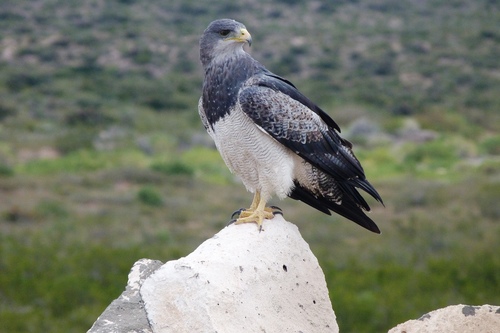
This species, commonly called the black-chested buzzard-eagle, is a large eagle-like buzzard (referred to as a hawk in American terminology). It has a total length of 62 to 76 cm (24 to 30 in) and a wingspan of 149 to 200 cm (4 ft 11 in to 6 ft 7 in). For the nominate subspecies, males average 2.13 kg (4.7 lb) and females average 2.75 kg (6.1 lb), with an overall weight range for both sexes of 1.67 to 3.17 kg (3.7 to 7.0 lb). The subspecies G. m. australis is slightly smaller in linear measurements; one recorded male weighed 1.7 kg (3.7 lb) and one recorded female weighed 3.2 kg (7.1 lb), showing that the overall body mass of the two subspecies is roughly similar. This bird has a noticeably bulky, powerfully built body. It has relatively long, broad wings, and a short slightly tapering tail that is black, with grey tips when plumage is fresh. When perched, the wings almost completely cover the tail, creating a distinctive appearance where the bird looks nearly tailless. Adult birds have a white underside, which sometimes has fine blackish stripes; their upperparts are dark grey, with blackish, brownish, or bluish undertones. The neck feathers and the lowest dark feathers on the breast are somewhat elongated. Adults have an ash-grey-and-white zone on their wings, and the silvery white portion is clearly visible from a distance. Females can be distinguished by a reddish-cinnamon color on their upperwing and underwing secondaries, and they are considerably larger than males. For standard body measurements, males have a wing chord of 463 to 555 mm (18.2 to 21.9 in), a tail length of 203 to 300 mm (8.0 to 11.8 in), a culmen length of 29 to 45 mm (1.1 to 1.8 in) and a tarsus length of 95 to 102 mm (3.7 to 4.0 in). In comparison, females have a wing chord of 490 to 566 mm (19.3 to 22.3 in), a tail length of 220 to 310 mm (8.7 to 12.2 in), a culmen length of 30 to 45 mm (1.2 to 1.8 in) and a tarsus length of 89 to 110 mm (3.5 to 4.3 in). Immature plumage is similar to that of the great black hawk (Buteogallus urubitinga). Immature birds have deep brown, sometimes almost black upperparts, and lack a light wing patch. Their underside is white or light buff, with heavy dark streaks on the breast and dark bars on the belly and thighs. They do not develop full adult plumage until they are 4 to 5 years old. This species is not very vocal, and usually only calls when in flight or near its nest. Some calls sound similar to a wild human laugh, while others are curlew-like whistles. Flying birds occasionally give a high-pitched "kukukukuku" vocalization. When in flight, adult black-chested buzzard-eagles are easily identified by their short wedge-shaped tail that barely protrudes from their long, broad wings, and their generally white underparts paired with a dark chest band and dark tail are usually easy to see. The black-chested buzzard-eagle inhabits mountainous or hilly terrain with sparse vegetation, shrubland, or in the southern portion of its range, Nothofagus forest. It spends much of its time soaring in thermals and vertical drafts while searching for prey. It requires large territories with suitable habitat; for example, páramos in the northern part of its range provide appropriate habitat conditions, but are too small overall, so the species is only recorded in the largest páramo patches such as Páramo de Frontino. It is most common between approximately 1,500 m (5,000 ft) and 4,600 m (15,000 ft) above sea level, and rarely enters lowland areas. This species builds nests in high trees or on rocky cliffs. If these sites are not available, it will nest on tall cacti, in bushes, or even directly on the ground. In Ecuador, nesting can be observed year-round; elsewhere, the breeding season may be more restricted, but existing information is limited and somewhat contradictory. The nest is a large mass of sticks, around 85 centimeters (33 in) in diameter. The black-chested buzzard-eagle is equally likely to reuse an existing nest or build a new one, and multiple abandoned nests are often found near an active nest. Males and females perform courtship flights and copulate over several weeks while pair bonding occurs. Little detailed information is known about the nesting process. Clutches usually contain 2 eggs, but may sometimes hold 1 or 3, and eggs are incubated for around one month. Nestlings are presumed to be covered in white down, similar to related species. While not aggressive under typical conditions, black-chested buzzard-eagles will fiercely attack humans if they perceive a threat to themselves or their young.