About Geranium maculatum L.
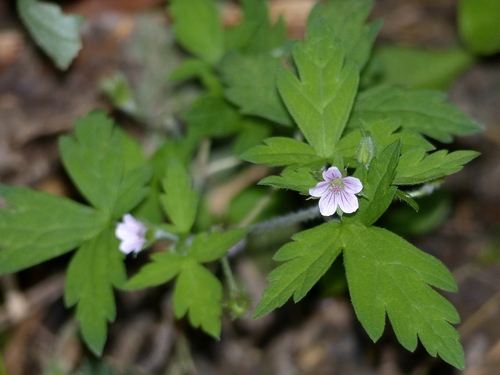
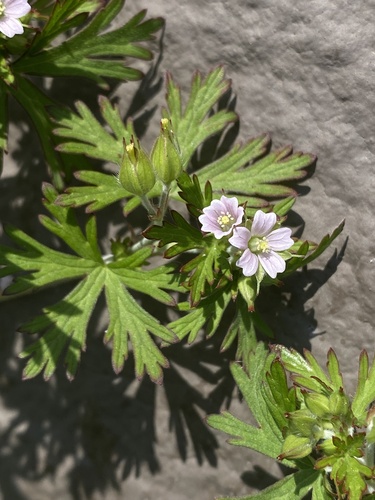
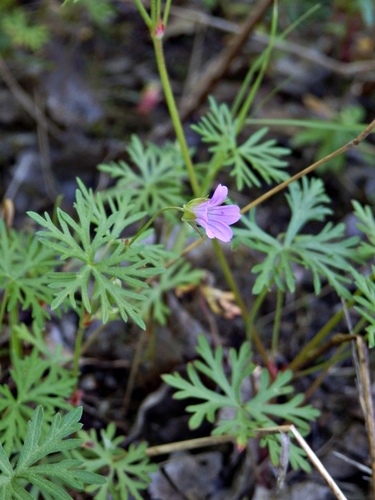
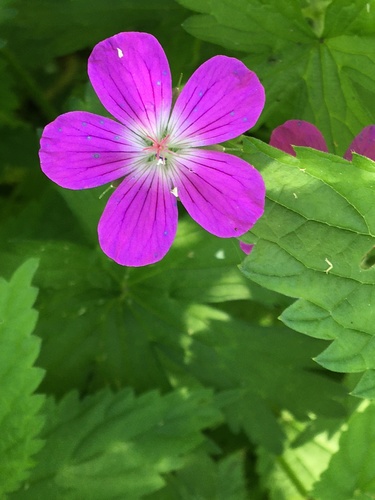
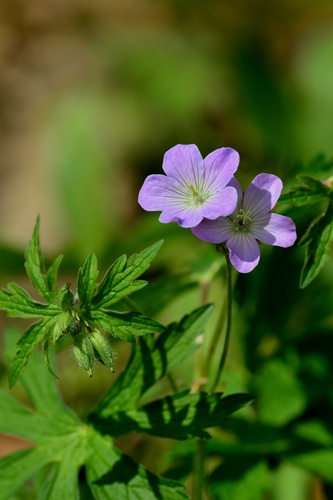
Geranium maculatum L. is a perennial herbaceous plant that reaches up to 60 cm (2 ft) in height. It produces upright, usually unbranched stems, and blooms from spring to early summer. Its leaves are palmately lobed with five or seven deeply cut lobes, measuring 10–12.5 cm (4–5 in) across. Each leaf grows from a petiole up to 30 cm (12 in) long that arises from the rootstock, and is deeply parted into three or five divisions, each of which is further cleft and toothed. The flowers are 2.5–4 cm (1.0–1.6 in) in diameter, with five rose-purple, pale, or violet-purple petals (rarely white) and ten stamens. In the Northern Hemisphere, flowers appear from April to June, with exact timing varying by latitude. They are arranged in loose corymbs or umbels holding two to five flowers at the top of the flowering stems. When ripe, the fruit capsule springs open. It is made of five cells, each holding one seed, joined to a long beak-like column 2–3 cm (0.8–1.2 in) long that grows from the center of the old flower, and this structure resembles a crane's bill. The plant has a long rhizome 5 to 10 cm (2 to 4 in) thick with numerous branches. The rhizome is covered in scars that mark the remains of stems from previous years' growth, and when dry it has a faintly purplish internal color. This species grows in dry to moist woodland habitats, and is typically abundant where it occurs. It is widely known in cultivation, and numerous cultivars have been developed; the cultivar 'Elizabeth Ann' has received the Royal Horticultural Society's Award of Garden Merit. It has been used in herbal medicine, and is also grown as a garden ornamental. Wild geranium is classified as an astringent, a substance that causes tissue contraction and stops bleeding. The Meskwaki people brewed a root tea from this plant to treat toothache and painful nerves, and mashed its roots to treat hemorrhoids.