About Geraea canescens Torr. & A.Gray
Nomenclature
Geraea canescens, which has the scientific name Geraea canescens Torr. & A.Gray, is commonly known as desert sunflower, hairy desert sunflower, or desert gold. It is an annual plant belonging to the family Asteraceae.
Etymology
The genus name Geraea originates from the Greek word geraios, meaning "old man", which refers to the white hairs that grow on the plant's fruits.
Stem and Flower Morphology
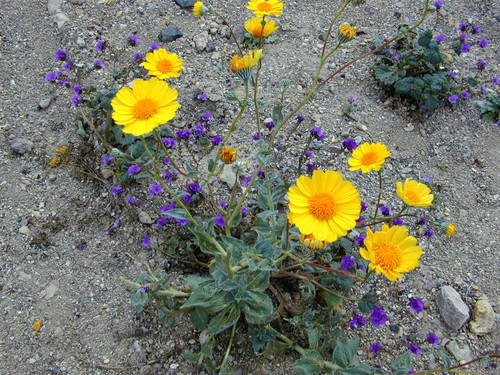
G. canescens produces yellow, sunflower-like flowers that grow on slender, hairy stems.
Size
The plant reaches a height between 0.30 and 0.91 metres (1 to 3 feet).
Leaf Morphology
Its leaves are gray-green and can grow up to 8 centimetres (3 inches) long.
Flowering Period
It flowers from February through May after it receives sufficient rainfall, and sometimes it also flowers in October and November.
Floral Structure
The flowers are 5 cm (2 in) wide, with 10 to 20 ray florets that each measure about 2 cm (3⁄4 in) long.
Native Distribution
This plant is native to western North America, and is specifically found in Arizona, Nevada, California, and Utah.
Habitat Regions
As a drought-resistant annual plant, it occurs in the California, Mojave, and Sonoran Deserts.
Elevation and Substrate
It grows at elevations ranging from −40 to 1,130 m (−130 to 3,700 ft), which includes elevations below sea level, in sandy desert soils alongside creosote bush (Larrea tridentata).
Ecological Role
It is one of the species that contributes to the occasional desert flower superblooms.
Varieties
Two varieties of this species are recognized: Geraea canescens var. canescens and Geraea canescens var. paniculata S.F.Blake.
Faunal Associations
The flowers of G. canescens attract bees and birds, and the plant's seeds are eaten by birds and rodents.