About Geothlypis tolmiei (J.K.Townsend, 1839)
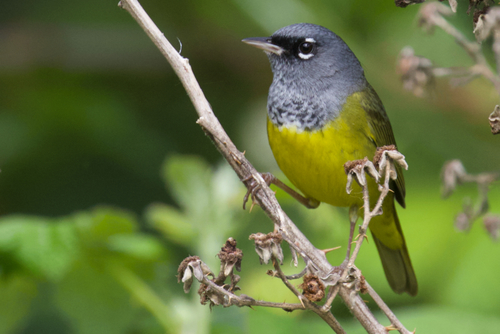
MacGillivray's warbler (scientific name Geothlypis tolmiei, first described by J.K. Townsend in 1839) is a species of New World warbler. These warblers are sluggish and heavy, and they spend most of their time on or near the ground, only leaving this area to sing. John James Audubon named this species to honor Scottish ornithologist William MacGillivray, while credit for its original discovery goes to John Kirk Townsend. The species' specific epithet tolmiei was chosen to honor William Fraser Tolmie. Adult MacGillivray's warblers have olive-green upperparts and dull yellow underparts. Males have black heads and breasts, while females and immature birds have drab light gray heads. Both sexes have broken white eye-rings. The species' song is made up of repeated two-note phrases that gradually increase in volume, ending with two single notes, commonly transcribed as jeeter jeeter jeeter JEETER JEETER jeet jeet. MacGillivray's warbler is very similar to the mourning warbler, its eastern counterpart; the main difference between the two species is that the mourning warbler does not have an eye-ring. Standard measurements for the species are: length 3.9–5.9 in (9.9–15.0 cm), weight 0.3–0.5 oz (8.5–14.2 g), and wingspan 7.5 inches (19 cm). This species is migratory. It spends the summer breeding season in temperate forests of the western United States and boreal forests of western Canada. In autumn, it migrates to Central America, where it overwinits in temperate shrublands.