About Geothlypis philadelphia (A.Wilson, 1810)
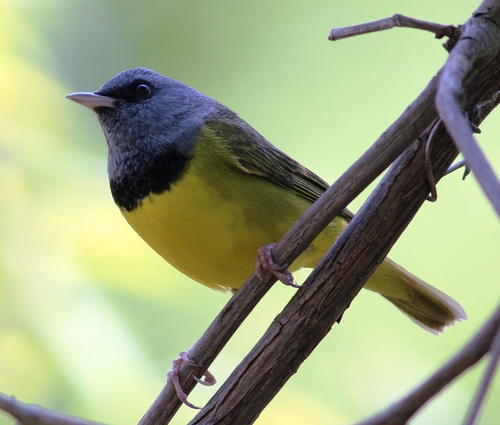
Identification: Mourning warblers are small songbirds with yellow underparts, olive-green upperparts, a thin pointed bill, and pink legs. Adult males have a gray hood, black lores, and a black patch on the throat and breast. In the fall, this plumage pattern becomes less bright, making the species harder to distinguish from similar species, but mourning warblers never have a broken eye ring. Females and immature individuals have gray-brown heads, an incomplete eye-ring, a yellow-gray throat, and a brown or olive tint to the breast. Both sexes range from 10 to 15 cm (3.9–5.9 in) in length, 11–13 g (0.4–0.5 oz) in weight, and have a wingspan of 18 cm (7.1 in). Besides MacGillivray's Warbler, similar species that can be confused with mourning warblers include Connecticut warblers, which have a complete eye ring, unlike the broken eye ring seen on immature mourning warblers. Immature Connecticut warblers also have a whiter chest, while immature mourning warblers have a yellow chest. Nashville warblers are also commonly confused with mourning warblers; Nashville warblers have a yellow throat, unlike the black or gray throats of mourning warblers. Female Nashville warblers have a gray back, and Nashville warblers are smaller and less active than mourning warblers. Distribution and habitat: During the breeding season, mourning warblers prefer second growth clearings. This habitat consists of thickets, semi-open areas with dense shrubs, dead fallen trees, and covered canopies. Second growth clearings can form from human activities such as mining, logging, and agriculture, or from natural events such as storms, natural fires, or insect outbreaks. In the Appalachians and the northernmost parts of their range, mourning warblers seek out habitat at higher elevations. These clearings are usually occupied by breeding warblers 1–2 years after disturbance, though some mourning warblers have been captured in areas 3–6 years after logging. After around 7 years, the habitat becomes too overgrown for breeding mourning warblers. Outside of the breeding season in winter, while they often occupy habitat similar to their breeding habitat, they can also be found in scrublands, dry woods, coasts, and urban areas, which differs from their breeding season habitat preferences. Range: While breeding, mourning warblers can be found in Newfoundland and Labrador, Nova Scotia, southwestern Northwest Territories, and northeastern British Columbia. Their southernmost breeding grounds include North Dakota, Minnesota, Illinois, Wisconsin, Michigan, the state of New York, Pennsylvania, West Virginia, and Virginia. Breeding populations of mourning warblers overlap with populations of several other warbler species, including the Kentucky warbler, Chestnut-sided warbler, and Connecticut warbler. Their winter range covers countries in Latin and South America. They are common in Ecuador, Venezuela, and Colombia, but have also been found in Nicaragua, Costa Rica, El Salvador, and the Dominican Republic. Local distribution of mourning warblers changes frequently, due to their preference for disturbed forests. Forest alteration events such as logging or agriculture occur in new moving locations over time, so mourning warbler populations shift to follow these new disturbed areas.