About Geothlypis beldingi Ridgway, 1882
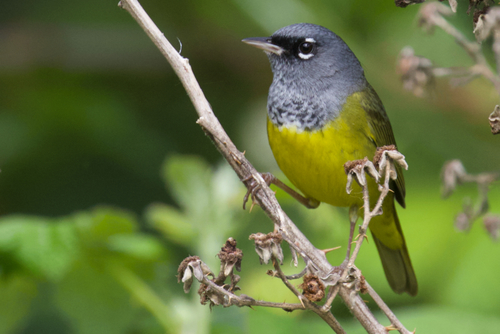
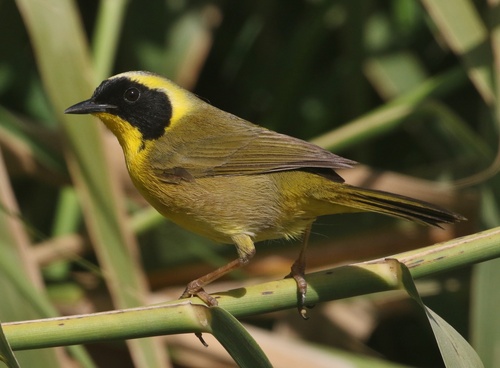
Belding's yellowthroat (Geothlypis beldingi) is a New World warbler. It is an endemic resident breeder found only on the southern Baja California Peninsula in Mexico. It is closely related to the common yellowthroat, Altamira yellowthroat, and Bahama yellowthroat, forms a superspecies with these birds, and was formerly considered conspecific with them. Its breeding habitat consists of freshwater marshes and lagoons, which usually contain cattails. It builds a cup-shaped nest out of dead cattails, which is typically attached low on the stem of a living cattail. It lays between 2 and 4 eggs, most commonly 3. Like other yellowthroats, it forages low in vegetation and feeds on insects and other small invertebrates. Adult Belding's yellowthroats measure 14 cm in length, with an olive-green back and a bright yellow belly. For the southern nominate subspecies G. b. beldingi, the adult male has yellow underparts, a black facemask, and a yellow forecrown. Females are similar in appearance but lack the black mask and have an olive crown. This subspecies is geographically separated from the similar Altamira yellowthroat by the full width of Mexico. The nominate southern race has been drastically impacted by habitat loss, and as of August 2007, it is restricted to several small marshes in southernmost Baja California: the estero at San Jose del Cabo and the lagoon at Todo Santos. The northern subspecies is G. b. goldmaii. Males of this subspecies have a pale belly and grey forecrown, which makes them very similar to some non-migratory southwestern races of common yellowthroat, though these races do not share an overlapping range with G. b. goldmaii. Belding's yellowthroat is larger and slightly brighter than migratory races of common yellowthroat that winter in Baja California, and the male's mask extends further onto the nape than it does on these visiting migratory birds. The northern G. b. goldmaii subspecies is still fairly common, but its range is shrinking due to habitat loss. The song of Belding's yellowthroat is a loud wichety wichety wichety wich. It is similar to the song of the common yellowthroat, but is deeper, fuller, and includes some buzzes. Its call is a soft jip, which is again similar to the call of the common yellowthroat. This species is named after Lyman Belding, a prominent Californian naturalist.