About Geospiza fuliginosa Gould, 1837
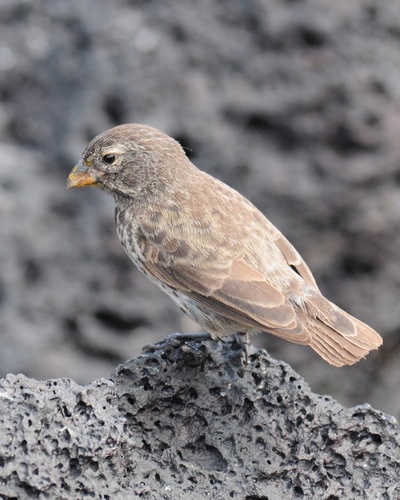
The small ground finch, scientifically named Geospiza fuliginosa Gould, 1837, is the smallest of all ground finches, with a total length of 11 cm (4.3 in). It has a short, pointed beak with a slightly curved culmen. On average, its beak is smaller than the beak of the medium ground finch, but there is substantial overlap in beak size between the two species, especially on islands where only one of the two species is present. When the two species compete directly on the same island, the difference between their beak sizes becomes larger. Adult males have entirely black plumage with white-tipped undertail coverts, while females and young finches are brown with streaks on their underparts. There are observable physical differences between small ground finches living in lowland areas and those living in highlands, and this variation is most likely caused by adaptation. Highland small ground finches have larger, more pointed beaks and smaller feet and claws than lowland members of the species. These finches form a cline, meaning a series of populations along a continuous environmental gradient, and individuals in the hybrid zone between the lowland and highland groups have intermediate traits. This system is an example of parapatric speciation: the 560-meter elevation gradient drives trait differentiation, while hybrids are well adapted to their hybrid zone. Like all but one of the other Darwin's finches, the small ground finch is endemic to the Galápagos Islands. It is abundant, widespread, and found on every island of the archipelago except Genovesa, Wolf, and Darwin islands. It is most common in arid coastal and transition habitat zones, though it moves into highland areas after the breeding season concludes.