About Geospiza fortis Gould, 1837
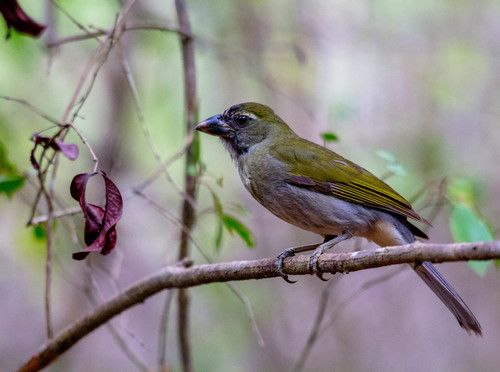
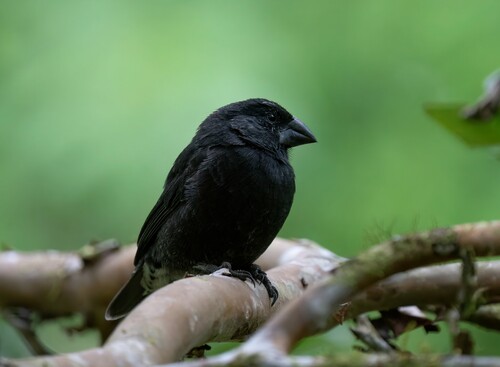
Like other members of its genus, the medium ground finch (Geospiza fortis Gould, 1837) is strongly sexually dimorphic. Females have brown, streaky plumage, while males have solid black plumage with white tips on their undertail coverts. This species reaches 12.5 cm (4.9 in) in length, which falls between the lengths of the small ground finch and large ground finch. Its bill varies quite a bit in size, but the length of the upper mandible is always greater than the depth of the bill at its base. On average, the species' wing shape changes with ecological shifts. Different selective pressures, including natural selection and sexual selection, act on the finches' wing shape. Males have shorter, rounder wings that help them maneuver around females during sexual displays. The medium ground finch is endemic to the Galápagos Islands, where it occurs on ten islands: Baltra, Floreana, Isabela, Fernandina, Seymour, Pinzón, San Cristóbal, Santa Cruz, Santa Fé, and Santiago. It can be found on most of the main islands, including their surrounding islets, and lives in semi-arid biomes. Males build dome-shaped nests for the species, most often in Opuntia cacti. Medium ground finches have higher survival chances in their habitat than small ground finches, a difference linked to their beak size. The beak size of medium ground finches can evolve over relatively short periods of time, depending on whether the season is wet or dry. Survival and beak size in these birds are shaped by environmental conditions. Weather conditions favor one beak size over another, leading to the death of birds with the unfavorable bill size. The HMGA2 gene locus is responsible for the evolution of beak size and plays an important role in natural selection. The size of an individual medium ground finch's home range varies based on multiple factors, including time of year, age, and sex. Incubating females are more likely to stay within their nesting territory. Finches are 3.7 times more likely to travel to a brooding area than any other location. Increasing urbanization in the Galápagos directly affects the nesting success of these finches. Nests in urban areas incorporate artificial materials such as plastic, fishing lines, paper, and human hair. These materials can cause death of the birds via strangulation, ingestion, and/or entanglement. While urban areas provide higher reproductive success overall, medium ground finches are harmed by the use of human-related debris in their nests. Although 97% of the Galápagos Islands are protected as a national park, growing human population has led to denser urban areas. The islands are highly vulnerable to anthropogenic changes, and urban development has a large impact on the environment, ecology, and evolution of native species like the medium ground finch. Environmental changes from urban development, such as increased light pollution and noise, directly affect the finches. Urbanization causes disruptions to ecological interactions and alters selection pressures, leading to selective modification of phenotypes. Areas with higher urbanization tend to have lower densities of medium ground finches, because greater human abundance leads to greater food abundance.