About Geositta rufipennis (Burmeister, 1860)
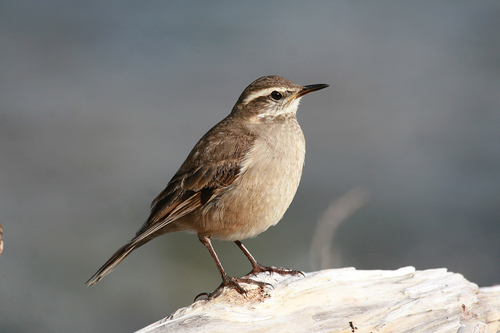
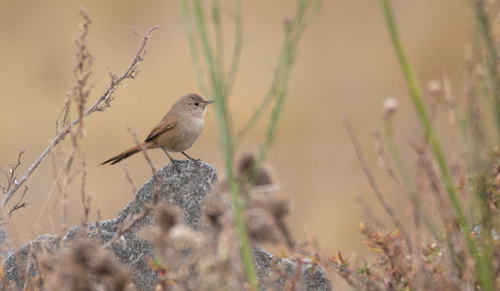
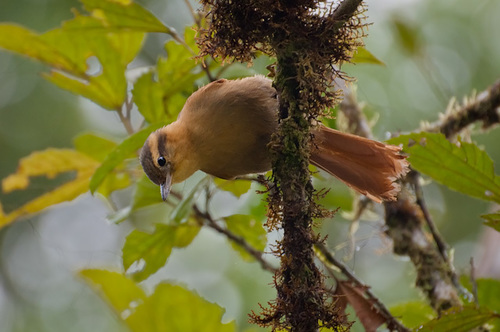
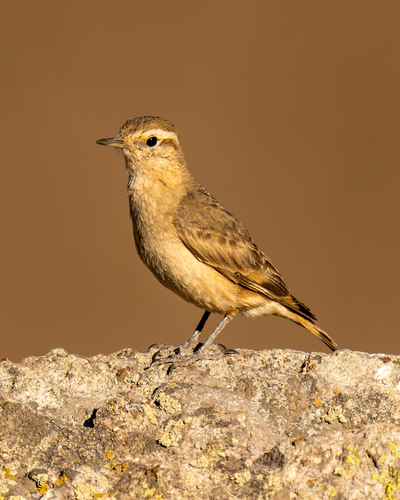
The rufous-banded miner (Geositta rufipennis) is a medium-to-large member of its genus, measuring 14 to 17 cm (5.5 to 6.7 in) long and weighing 25 to 54 g (0.88 to 1.9 oz). The sexes have identical plumage and size. The nominate subspecies G. r. rufipennis has a brownish gray face with a pale supercilium and a dark gray-brown line behind the eye. Its plumage from crown to uppertail coverts is dull sandy olive. Its central tail feathers have dull tawny bases, grayish brown middles, a wide blackish band near the tip, and dull tawny ends; the other tail feathers have progressively redder bases and smaller black bands toward the outermost feather. The wing is dull gray brown with paler feather edges, and the flight feathers have rufescent bases that form a wide band. The throat is whitish, the breast pale brownish buff, the belly and flanks paler with a cinnamon tinge, and the undertail coverts dull pale tawny. Its iris is brown, its straight medium-length bill is blackish gray with a pale horn base to the lower mandible, and its legs and feet are blue-gray. All other recognized subspecies differ from the nominate in both size and coloration. G. r. ottowi is larger and grayer than the nominate, with narrower wing bars and a paler underside to the wings. G. r. hoyi has almost entirely gray upperparts; its underparts are mostly pinkish gray, with a less pinkish tone on the breast. G. r. giaii is similar to hoyi, but is slightly darker gray on the upperparts, has narrower wing bands, and a significantly longer bill. G. r. fasciata has grayer upperparts and is darker overall than all other subspecies. G. r. harrisoni is the smallest subspecies; compared to fasciata it has a whiter belly and little or no rufous color on its flanks and undertail coverts. Different subspecies of the rufous-banded miner have distinct distributions across western South America: G. r. fasciata is found in western Bolivia and on the Pacific slope of Chile between the Atacama Region and Malleco Province; G. r. harrisoni occurs in southwestern Antofagasta Region of northern Chile; G. r. rufipennis is located in northwestern Argentina between Jujuy and San Juan provinces; G. r. giaii ranges in southwestern Argentina between Neuquén and Chubut provinces, and possibly occurs further south in Argentina and in far southern Chile; G. r. ottowi is restricted to the Sierras de Córdoba in west central Argentina; G. r. hoyi is found in western Argentina between La Rioja and Neuquén provinces, and in southern Chile's Aysén Region. The rufous-banded miner inhabits a variety of open landscapes, including puna grassland, arid montane scrublands, dry rocky slopes, flat areas with scattered vegetation, and dry riverbeds. In the Andes, it occurs at elevations between 3,100 and 4,400 m (10,200 and 14,400 ft). East of the Andes in central Argentina it occurs as low as 2,200 m (7,200 ft), and it reaches almost sea level in Chile's Atacama Province.