About Geositta punensis Dabbene, 1917
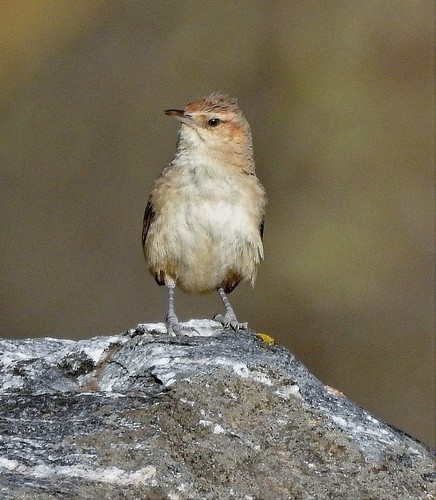
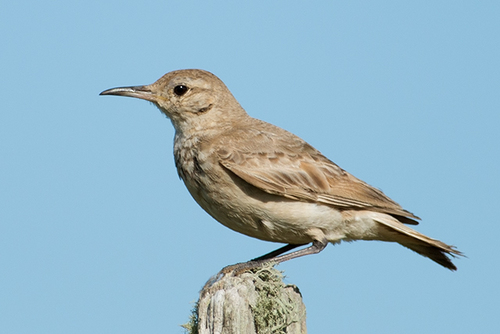
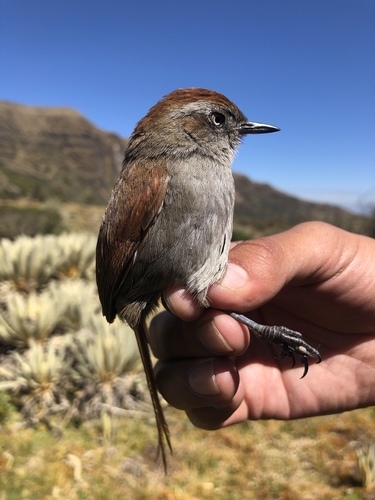
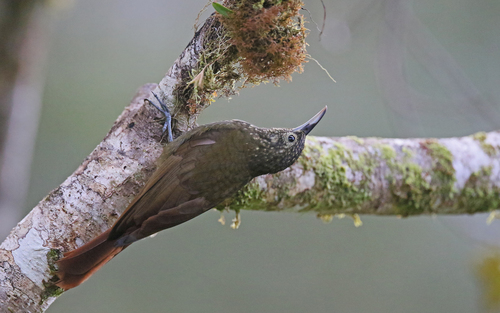
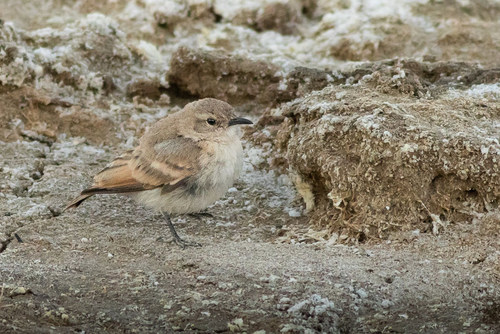
Geositta punensis, commonly known as the puna miner, is a medium-sized bird in its genus. Adults measure 13.5 to 14 cm (5.3 to 5.5 in) in length and weigh 22 to 29 g (0.78 to 1.0 oz), with no visible differences between males and females. It has a pale grayish brown face marked by a buffy whitish supercilium. From crown to rump, its plumage is pale sandy brown, with even paler uppertail coverts. The tail feathers have pale tawny rufous bases, dark brownish to blackish middle sections, and pale tawny rufous tips. The pale basal area of the tail feathers grows progressively larger from the innermost to outermost feathers, and the outermost feathers have almost entirely white outer webs. Its wing coverts and flight feathers are dark brownish with whitish buff tips; the flight feathers also have pale tawny rufous bases that form a visible band when the bird is in flight. Its throat, breast, and belly are pale buff-white, with a pale tawny tinge on the flanks. It has a brown iris, a medium-length bill that is blackish with a blue-gray base to the lower mandible, and dark gray legs and feet. The puna miner lives on the Altiplano, a high elevation plateau in the Andes of far southern Peru, western Bolivia, northeastern Chile, and northwestern Argentina. Within this range, it inhabits puna grasslands and barren areas, and it can sometimes be found on open slopes above brushy ravines. Most individuals live between 3,200 and 4,600 m (10,500 and 15,100 ft) in elevation, but the species occurs as low as 3,050 m (10,000 ft) and as high as 5,000 m (16,400 ft).