About Geositta peruviana Lafresnaye, 1847
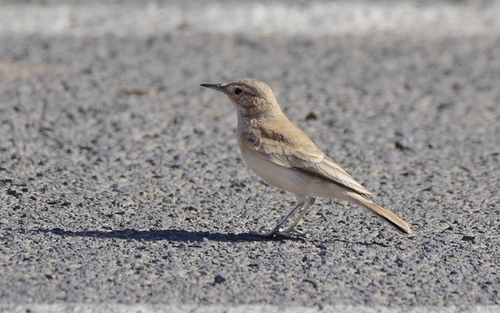
The coastal miner (Geositta peruviana) is a small bird in the Geositta genus. Adults measure 12 to 14.5 cm (4.7 to 5.7 in) in length and weigh 16 to 19 g (0.56 to 0.67 oz). Males and females have identical plumage. The nominate subspecies has pale brown upperparts, with slightly paler uppertail coverts. The other two subspecies have a lighter pale sandy brown coloration on their upperparts. The central pair of tail feathers is brown for the nominate subspecies, and sandy brown for the other two. For all subspecies, the next three pairs of tail feathers are black with narrow creamy white tips. The following pair is mostly blackish brown. The outermost pair of tail feathers has a creamy white outer web, a pale rufous inner web, and a dark band near the creamy tip. The flight feathers are mostly pale rufous or tawny buff, with dusky tips and a buffy band that is visible when the bird is in flight. The bird has a pale supercilium on its face. Its underparts are creamy white. It has a dark brown iris, a blue-gray bill with a black outer third, and legs that range from whitish gray to greenish silver. This species is endemic to Peru. The three subspecies occupy separate ranges along the country’s coast: the northernmost subspecies G. p. paytae occurs in northwestern Peru, between the departments of Tumbes and Ancash; the nominate subspecies occurs in central Peru, from Ancash south to Lima; G. p. rostrata is found only in the southwestern Department of Ica. The coastal miner inhabits open sandy areas of the coastal plain, ranging from seaside dunes inland to almost the base of the Andes. Its elevation range extends from sea level up to 700 m (2,300 ft).