About Geophila macropoda (Ruiz & Pav.) DC.
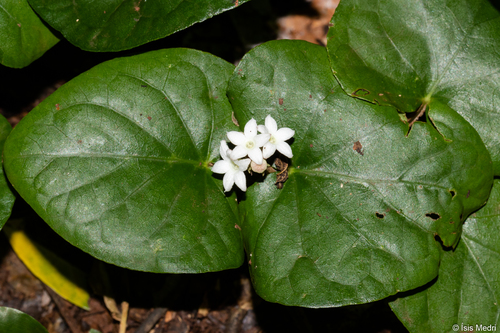
Geophila macropoda (Ruiz & Pav.) DC. is a herbaceous, perennial plant with creeping stems that grow along the ground and root at their nodes. Each node produces 1 to 4 oppositely arranged leaves. The leaves are roundish with deeply lobed bases, and can grow up to 9 centimeters (around 3½ inches) long. Rabbit-ear shaped stipules grow at the base of each leaf petiole. This species produces few-flowered, head-clustered inflorescences that sit directly above two involucral bracts, which reach up to 3 millimeters (3⁄32 inch) long. Below the involucral bracts is a peduncle that is roughly the same length as the leaf petioles, and grows considerably longer as fruits ripen. Individual flowers in the clusters grow from very short pedicels. The corollas are white, funnel-shaped, and have hairy throats. The fruits are purplish black, roundish drupes with fleshy interiors. Each drupe holds two hard-coated stone seeds, and measures about 1 centimeter (around ½ inch) from top to bottom. Mature fruits retain a persistent calyx limb, a slender crown made of sepals, at their apex. Among Peruvian Geophila species, Geophila macropoda is set apart by its mostly hairless plant body (only young petioles have short hairs) and its broadly rounded, heart-shaped leaf blades. Georeferenced records on the iNaturalist map show that Geophila macropoda ranges from southern Mexico south through Central America into northern and western South America, extending as far south as southern Brazil and northern Argentina. In Colombia, Geophila macropoda grows as a cover plant in cacao plantations located on alluvial soil in humid tropical climates. Leaves become smaller and more chlorotic as ground-level light intensity increases. The species does not compete with cacao plants, while it suppresses the growth of undesirable weed species. When its leaves and other plant parts die and decompose, they add organic matter to the soil. In Peru's Ucayali region, it grows at 300 to 350 meters (around 980 to 1150 feet) elevation, found in secondary forests and occasionally flooded lands. Images of the species from Guatemala were taken along a trail in the shady forest of El Rosario National Park, in the department of Petén at 125 meters (410 feet) elevation. In traditional medicine practices of the Peruvian Amazon, the Huni Kuin people make mouthwashes from a decoction of Geophila macropoda leaves to treat inflamed molars and gum abscesses. The Yanesha people of the Peruvian Amazon rainforest use the fresh plant crushed into a poultice applied to fungal infections between the toes. One preparation method calls for preheating the leaves by wrapping them in another leaf and holding them over a flame, then squeezing the hot leaf juice over the infected area. The Yanesha also use this plant to treat pimples on children's bodies: they rub the fresh plant on the affected area daily for several days until the pimples clear.