About Geometra papilionaria (Linnaeus, 1758)
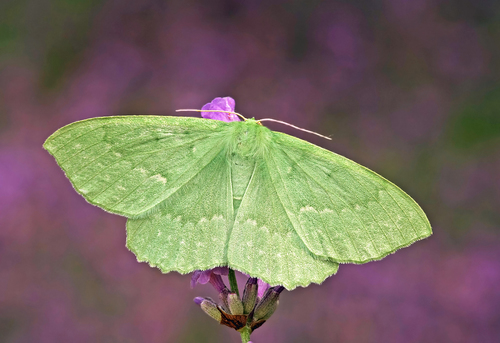
This is a large, attractive moth that, as its specific name suggests, is very butterfly-like. It has a wingspan of 50–65 mm. Newly emerged adults are distinctly pale green, with slightly darker green and especially white fascia; the green coloration fades after a few days. The characteristic white fascia appear as three jagged, broken lines of white spots on the forewings, and two semicircular rows of these lines continue across the hindwings. In the technical description of the species and its life stages: the moth is bright green, with the forewing usually marked by two lunulate-dentate white lines and the hindwing marked by one. The lunules are thickest in the submedian area of the forewing; both wings usually also have a faintly darker green cell-mark, plus some indistinct white intraneural spots distal to the postmedian line. The underside has similar but weaker markings, with no antemedian line. Several named aberrations are documented: ab. herbacearia Men. is a form where both white lines are completely absent; it was originally described as a separate species from Amurland. ab. cuneata Burr has an extra large wedge-shaped white spot located proximal to the discal mark, in addition to the usual markings. ab. subcaerulescens Burr has a bluer green ground color than the typical form, but is probably scarcely worth taxonomic recognition. ab. deleta Burr is another minor aberration where the distal series of white spots is completely absent. In ab. subobsoleta Burr, the antemedian line of the forewing is also absent. ab. alba Gillm. is entirely white on both the upper and underside, with a slight yellowish tinge. The egg is approximately oval, broader and flattened at one end. It appears strong and heavy, with a sculptured surface featuring clearly defined cells, and the micropyle forms a shallow, circular rayed pit. Larvae feed on birch and alder, and their striking protective adaptations have been closely studied. They are rather stout and rugose, with a shagreened surface, a slightly notched head, and setae that mostly have enlarged tips. Larvae hibernate when small, and are brown at this stage, matching the coloration of tiny twigs for protection. In spring, many individuals turn green, and become remarkably similar in appearance to the birch catkins they feed on. Small protuberances and the projecting edges of body segments increase this protective resemblance. The pupa is cylindrical, tapering steadily from the fourth abdominal segment to the anal tip. Its spiracles and tubercles are distinct; the tubercles are dark-colored and bear short curved setae. The anal armature consists of 8 hooks. The pupa is generally pale green, with brown-tinted wing cases.