About Geokichla citrina (Latham, 1790)
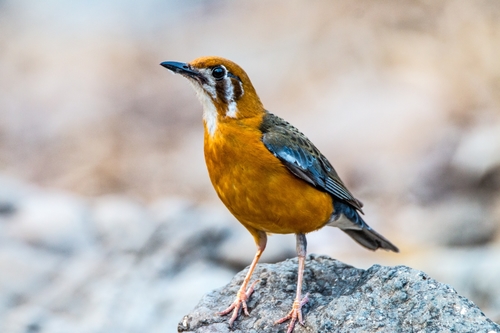
The orange-headed thrush, Geokichla citrina, measures 205–235 millimetres (8.1–9.25 in) in length and weighs 47–60 grammes (1.7–2.1 oz). This small thrush shows clear variation in plumage by age and sex for the nominate subspecies. The adult male of the nominate subspecies has a fully orange head and underparts, uniformly grey upperparts and wings, and white median and undertail coverts. Its bill is slate-coloured, and its legs and feet have brown fronts with pink or yellowish rears. Females resemble males, but have browner or more olive upperparts and warm brown wings; however, some older females are nearly identical to males. Juveniles are dull brown with buff streaks on the back, a rufous tone to the head and face, and grey wings. Their bill is brownish horn, and their legs and feet are brown. This species’ combination of orange and grey plumage is very distinctive, so it is not easily confused with any other species. Differences between subspecies can be quite striking, such as the strong head pattern found on G. c. cyanota, but other differences may be subtle variations in plumage tone, or the presence or absence of white on the folded wing. Like many other thrushes, all forms of this species have a distinctive underwing pattern marked by a strong white band. The orange-headed thrush breeds across much of the Indian subcontinent, including Bangladesh, India, and Sri Lanka, and ranges through Southeast Asia to Java and southern China. Its preferred breeding habitat is moist broadleaved evergreen woodlands with medium-density undergrowth made up of bushes and ferns, but it also uses secondary growth bamboo forests. The subspecies G. c. cyanota additionally lives in large gardens and orchards. This species is often found in damp locations, near streams, or in shady ravines. In the Himalayas, it occurs between 250 and 1830 metres (825– 6040 ft), while in Malaysia, Thailand, and Java, it occurs up to about 1500 metres (5000 ft). The subspecies G. c. aurata is resident between 1000 and 1630 metres (3300–5400 ft) on Mt Kinabalu and Mt Trus Madi in northern Borneo. Some subspecies are completely or partially migratory; their wintering habitat is similar to the breeding forests they use, but wintering populations are more commonly found at lower altitudes.