About Gentiana pannonica Scop.
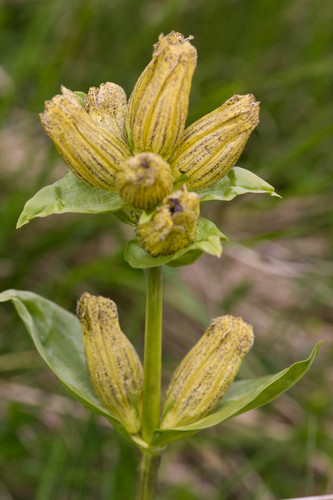
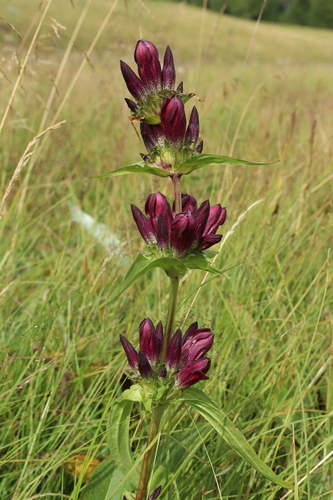
Hungarian gentian, scientifically named Gentiana pannonica Scop., is a perennial herbaceous plant that reaches heights between 20 and 60 centimetres. All above-ground parts of this plant are hairless, and it produces an upright, strong stem. Its leaves have five to seven veins, are arranged in opposite decussate pairs, with lower leaves being elliptic and petiolate, and upper leaves being lanceolate and sessile. Hungarian gentian flowers between July and September; its flowers grow in upper leaf axils or are clustered at the tip of the stem. The flowers are hermaphroditic, radially symmetrical, and have a double perianth. The green sepals are fused, forming a bell-shaped calyx with five to eight outward-curving teeth. The bell-shaped corolla is 25 to 50 millimetres long, wider at the apex, and has five to nine petals that reach the middle of the corolla. The tip of each corolla lobe is ovate; the outer surface of the petals is red-violet with black and red spots, while the inner surface is usually yellowish. The chromosome number of this species is 2n = 40. This gentian is native to the Eastern Alps, Bergamasque Alps, Carpathians, and Transylvania. Its western distribution boundary runs through Allgäu and eastern Switzerland, which aligns with the eastern distribution boundary of the purple gentian. In Austria, it occurs sparsely to moderately across much of the country, for example on Krippenstein in the Dachstein Mountains, and is absent from Vienna and Burgenland. In Germany, it grows on alpine pastures in the Bavarian Forest, including within the Bavarian Forest National Park. Hungarian gentian grows best on calcareous soil, but can also survive on soils low in calcium. In Central Europe, it can be found in perennial meadows, cirques, bogs, and mountain pine shrubland. It is a character species of the Nardion plant community, and also occurs in plant associations belonging to the rhododendro-vaccinienion sub-group. It is an old medicinal herb, used in the same way as yellow gentian. Past intense harvesting reduced its populations to small isolated remnants, so the IUCN has classified it as near threatened. Existing habitat management plans have been created or adjusted to support conservation of this species.