About Gentiana lutea L.
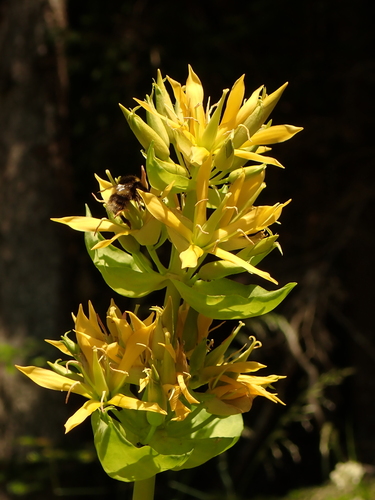
Gentiana lutea L. is a herbaceous perennial plant that grows 1 to 2 meters (3.3 to 6.6 feet) tall. It bears broad, lanceolate to elliptic glabrous leaves in opposite pairs; each leaf measures 10 to 30 centimeters (4 to 12 inches) long and 4 to 15 centimeters (2 to 6 inches) wide. Its yellow flowers are 18 to 24 millimeters long, with a corolla divided nearly to the base into 5 to 7 narrow petals. Flowers grow in whorls of 3 to 10 on the upper section of the stem, and bloom from June to August. This species grows in grassy alpine and sub-alpine pastures, most often on calcareous soils, at elevations up to 2500 meters. All parts of Gentiana lutea, including its root, have an intense bitterness. Its dried underground plant parts are used, and the root itself is long and thick: it is typically around 30 centimeters (12 inches) long and 2.5 centimeters (1 inch) in diameter, but can reach 90 centimeters or more in length and 5 centimeters in diameter. It is yellowish-brown in color and very bitter to taste. Rhizomes and roots are collected in autumn then dried. Historically, gentian was occasionally used in brewing. Gentian root has a long history of use as an herbal bitter, and is an ingredient in many proprietary medicines. In 1860s veterinary pharmacopeia, gentian root (also called gentian radix) was recognized as a useful tonic and stomachic. Gentian root extracts appear in several liqueurs. In France, it is used to make a number of bitter genziana liqueurs, including Salers from Cantal, and Avèze, a specialty liqueur and aperitif from Limousin. Due to its protected status, this plant is now cultivated in the Auvergne region, and is no longer harvested from the wild in the Auvergne mountains. Care should be taken when using this plant, as it is endangered in some regions, even though the full species is not globally threatened. The related species Centaurium erythraea shares many of its constituents and effects. The species name honors Gentius, an Illyrian king thought to have discovered the herb’s tonic properties. The European Gentian Association based in Lausanne works to develop knowledge and uses of yellow gentian and other species in the Gentianaceae family. Gentiana lutea appears on the reverse of the 2000 lek Albanian banknote, issued in 2008; the obverse of this banknote features a portrait of King Gentius.