About Genoplesium pumilum (Hook.f.) D.L.Jones & M.A.Clem.
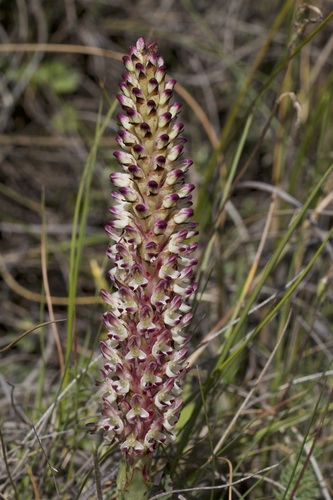
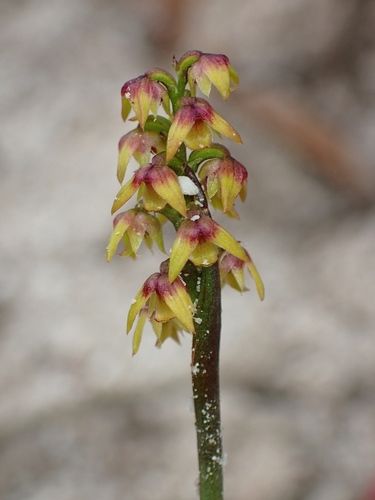
Genoplesium pumilum (Hook.f.) D.L.Jones & M.A.Clem. is a terrestrial, perennial, deciduous herb that grows from an underground tuber. It produces a single thin leaf 100–200 mm (4–8 in) long, which is fused to the flowering stem, with a free section 10–20 mm (0.4–0.8 in) long. Between five and twenty-five green to yellowish-green red flowers are crowded along a flowering stem 15–25 mm (0.6–1 in) long; this stem is taller than the leaf. The flowers lean forwards, are about 5 mm (0.2 in) long and 3 mm (0.12 in) wide, and sometimes have red markings. Like other species in the Genoplesium genus, the flowers of G. pumilum are inverted, so the labellum sits above the column rather than below it. The dorsal sepal is egg-shaped, about 2 mm (0.08 in) long and 1.5 mm (0.06 in) wide, and sometimes has a small gland on its tip. The lateral sepals are linear to lance-shaped, about 4 mm (0.16 in) long and 1 mm (0.04 in) wide; they spread apart from each other and often have a gland at the tip. The petals are egg-shaped, about 2 mm (0.08 in) long and 1 mm (0.04 in) wide, with hairless margins and sometimes a gland on the tip. The labellum is egg-shaped, thick and fleshy, 2.5–3 mm (0.098–0.12 in) long and 1.5–2 mm (0.06–0.08 in) wide, with fine teeth along its edges. A callus sits in the centre of the labellum, and extends almost to its tip. Flowering occurs between January and May in Australia, and between February and October in New Zealand. Genoplesium pumilum grows in wet heath, wallum, and the edges of swamps. In Tasmania, it grows on buttongrass plains, and in New Zealand it grows in sparsely vegetated gumland scrub. In New South Wales, it occurs mainly in coastal districts, while in Victoria it is found in the far east and on French Island. It is also common in coastal areas of Tasmania, and in New Zealand it is found on the North and Chatham Islands.