About Genoplesium fimbriatum (R.Br.) D.L.Jones & M.A.Clem.
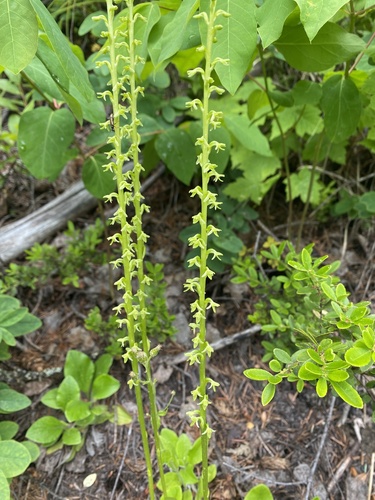
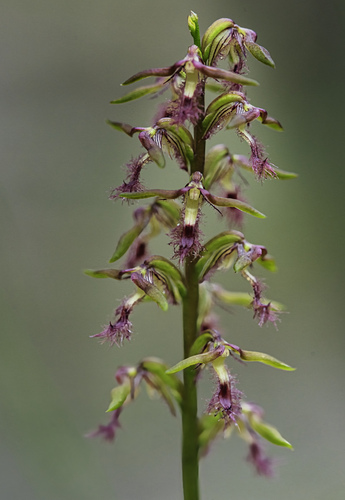
Genoplesium fimbriatum is a terrestrial, perennial, deciduous herb that grows from an underground tuber. It produces a single thin leaf 200–350 mm (8–10 in) long, with a free section of the leaf measuring 20–30 mm (0.8–1 in) long. Between five and thirty lemon-scented flowers are crowded along a flowering stem that grows 50–100 mm (2–4 in) tall. The flowers are green to brownish-green with red stripes, and measure 12 mm (0.5 in) long and 9–11 mm (0.35–0.43 in) wide. Like other species in the Genoplesium genus, the flowers of this species are inverted, meaning the labellum sits above the column rather than below it. The dorsal sepal is egg-shaped, 4–5 mm (0.16–0.20 in) long and 2–3 mm (0.08–0.1 in) wide, marked with red stripes, with a hairy edge and a sharp tip. The lateral sepals are linear to lance-shaped, 5–6 mm (0.20–0.24 in) long and 1–1.5 mm (0.04–0.06 in) wide. They are separate from each other and spread widely apart. The petals are egg-shaped with pointed tips, about 3 mm (0.1 in) long and 1 mm (0.04 in) wide, marked with stripes and bearing long hairs along their edges. The labellum is linear, 4 mm (0.2 in) long and 1 mm (0.04 in) wide, with an upward-curled red tip and long pink to red hairs along its edge. The labellum quivers even in the lightest breeze. Flowering occurs between December and May. Genoplesium fimbriatum grows in a range of habitats, including open forest, heath, and moss gardens. It is found in near-coastal areas and adjacent tablelands between Stanthorpe and Vincentia. It often grows in areas with frequent wildfires and relatively high rainfall.