About Genista monspessulana (L.) L.A.S.Johnson
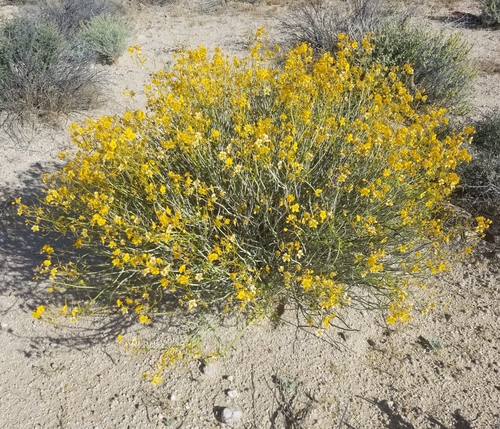
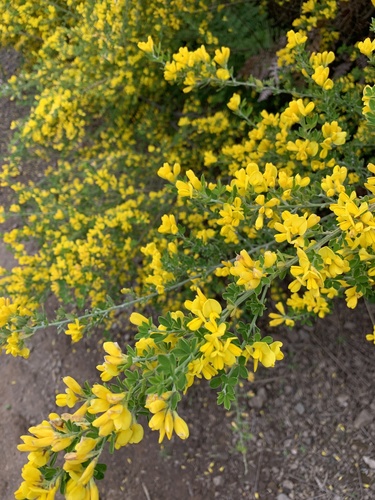
Genista monspessulana grows 1 to 2.5 metres (3+1⁄2 to 8 feet) tall, with slender green branches. Young stems are typically ridged or angled, and green in color. Its evergreen leaves are trifoliate, with three narrow obovate leaflets that measure 1 to 2 centimetres (1⁄2 to 3⁄4 inch) long. Its yellow flowers grow in clusters of 3 to 9 within short racemes. Like other legumes, this plant produces seeds inside a pod. The pods are 2 to 3 cm (3⁄4 to 1+1⁄4 in) long, tough and hard, covered entirely with hairs, and are easily transported by flowing water and animals. Pods burst open forcefully to disperse seeds several metres away. The plant starts producing seeds once it reaches approximately 40 cm (16 in) tall, and has a total lifespan of 10 to 20 years. A single mature plant can produce 10,000 seeds per growing season. Its high seed output and ability to resprout after cutting or burning allow it to vigorously invade new habitats when introduced outside its native range. It is related to common broom and Spanish broom. Genista monspessulana and related species are common in European shrublands. French broom, the common name for this species, was originally native to Mediterranean Europe, northwest Africa, the Azores, and the Canary Islands. Because it is less tolerant of frost than other broom species, it is most common in warmer, low-elevation areas. It grows on coastal strips and in sunny inland areas, and performs best with plentiful rainfall and sandy soils. When introduced outside its native range, French broom can become an invasive plant. Its strong reproductive capacity and preference for Mediterranean climates make it a very successful invasive species in California and the Pacific Northwest, where it is classified as a severe noxious weed and covers over 40 kilohectares. It is even more widespread in Australia, where it covers 600 kilohectares and is also classified as a noxious weed. This plant often outcompetes native vegetation, forming dense stands that crowd out almost all other species. Thick stands of French broom can render meadows and pastures unusable for wild and domestic animals. It can also shade out tree seedlings in reforested areas, and its foliage tends to catch fire easily. The leaves and seeds of Genista monspessulana contain alkaloids that are poisonous to many large domestic animals.