About Gellonia dejectaria (Walker, 1860)
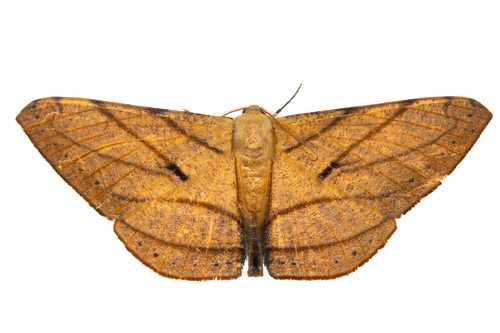
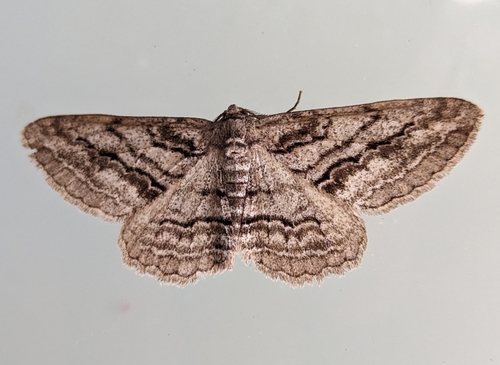
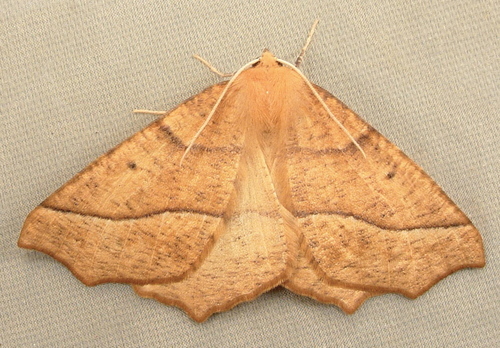
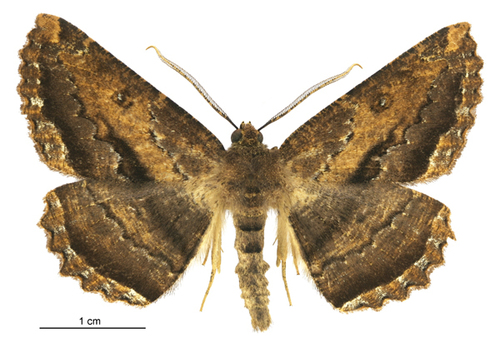
Francis Walker originally described the male of Gellonia dejectaria, the brown evening moth, as having a slender body, deep brown upper body, yellowish ashy underside, and a thickened middle segment on its hind legs. Male antennae feature narrow, parallel comb-like projections extending all the way to the tip, a trait unique to males of this species. Walker described the moth's wings as large and freckled, with a dull brick-red color. The upper surface of the wings bears thin black lines on both its inner and outer sections, and the forewing (the larger wing) holds an almost black dot that contains a small white spot inside it. A broad band runs along the underside of the wing, and brown dots are present on the underside closer to the moth's body. The moth's wingspan can reach up to 2 inches (5.08 cm), and it usually has an additional white dot in the middle of the outer edge of the forewing. Identification of this species can be difficult because of its high variability, but it can be distinguished from similar species by its larger wings and body, plus the very slanted cross lines on the forewing. The caterpillar (larva) of the brown evening moth varies greatly in color, usually matching its food plant and surroundings. All larvae of this species have a distinctive large hump on the third body segment. Documented color variations include matching the twig color of mahoe (Melicytus ramiflorus), dark reddish-brown when found on white rata/akatorotoro (Metrosideros perforata), purplish black on poroporo (Solanum aviculare), and pale olive-green with brown hints on fuchsia (Fuchsia excorticata), matching the color of that plant's new sprouting twigs. In addition to confusing identifiers through color variation, caterpillars often change their appearance to blend into their surroundings, especially in early life stages. Like most geometrid moths, these caterpillars will tuck their first two pairs of legs tightly against their body and position their third pair of legs straight downward, to mimic a broken thorn or twig and blend into their host plant's branches. However, the resting leg position of brown evening moth caterpillars is unique to this species. The eggs of the brown evening moth are roughly 1⁄32 inch (0.079 cm) long and irregularly oval in shape. They are typically dark green when first laid, and covered in a pattern of large hexagonal indentations. Each angle of these hexagonal shapes bears a tiny, bright white point. As eggs develop, they darken to a reddish-brown color, but the small bright white points at the hexagon angles remain bright white. Overall, the eggs have a striking, vivid speckled appearance. The brown evening moth is endemic to New Zealand, and is not known to occur anywhere else in the world. Within New Zealand, this species is very common and found throughout the entire country, from large towns and cities to remote wilderness areas. Outside the New Zealand mainland, it has also been recorded on Stewart Island, Southland. It can inhabit almost any area across New Zealand, but in unmodified, undeveloped habitats it is most commonly found in shrublands and native forests, where it rests on logs with its wings folded flat against its back. It is very frequently observed near people, with most sightings occurring on human structures including outhouses, sheds, and shaded home walls across New Zealand, extending to Stewart Island. The brown evening moth begins life as an egg, laid loosely across irregular branches of a wide variety of food plants. Eggs are loosely attached to one another on host plants including mahoe (Melicytus ramiflorus), white rata/akatorotoro (Metrosideros perforata), and poroporo (Solanum aviculare). Larvae can generally be found throughout the New Zealand summer into early autumn, from approximately December to March. A typical larval brood reaches full size (1.5 inches or longer) in late autumn, then enters the pupal stage inside a chamber it constructs 1 to 2 inches below the soil surface, with adults emerging between November and May. According to Gaskin and Hudson, there are at least two, and possibly three, distinct broods of this moth based on their life event timing. The second brood overwinters in the pupal stage before emerging in early spring. A third brood likely emerges near the end of summer (February) and hibernates as an adult, as adult brown evening moths have been recorded coming to light on winter nights in June and July.