About Gazania linearis (Thunb.) Druce
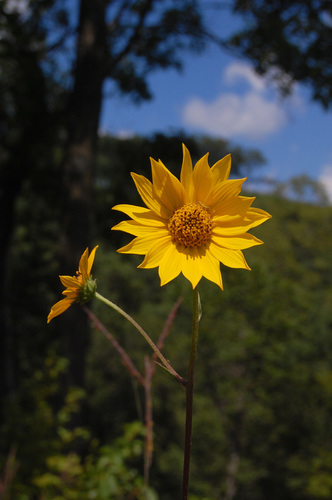
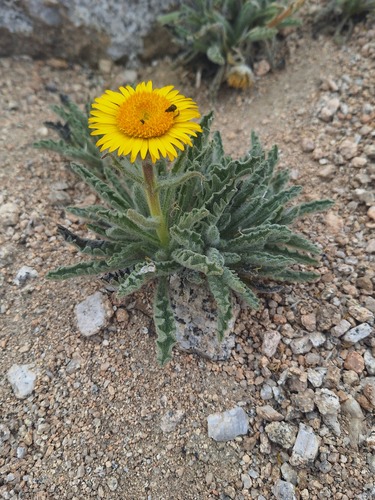
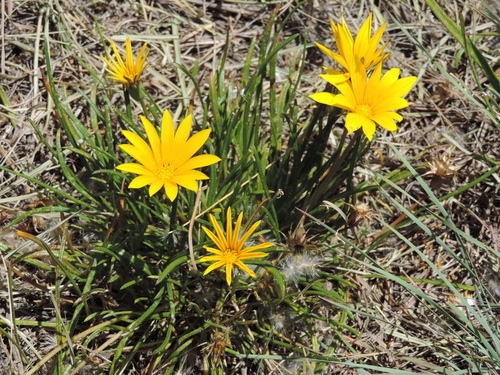
Gazania linearis is a clumping perennial herb. Its leaves are usually slender and linear, mostly simple, though they can sometimes be slightly pinnate. Lower leaf margins are rough and spiny-to-ciliate. The upper leaf surface is dull green, while leaf undersides are covered in white woolly tomentose hairs. Leaves have long, winged petioles, and form basal rosettes at ground level around the plant’s short branching stem. Unlike the type variety of G. linearis, which has linear leaves, the rare variety G. linearis var. ovalis has more oval-shaped leaves, and is only known from a small area near Grahamstown. The plant produces large, solitary daisy-like flower-heads that are always bright yellow. Ray florets may have dark spots near their bases, curl upwards along their edges, and close at night. The involucre is either subcupuliform or obtusely bell-shaped (campanulate). Both the involucre and scape can be either glabrous or setose. There are usually some parietal bracts arranged around the involucre. Among the terminal involucre bracts, the outer row is linear with setose-ciliate margins, while the inner row is acuminate with membranous-entire margins. The fruit is a tiny achene covered in very long hairs that are several times longer than the body of the fruit itself. G. linearis var. linearis, the variety with linear leaves, is indigenous to southern and eastern South Africa, where it ranges from Humansdorp in the Western Cape, eastwards to KwaZulu-Natal Province. G. linearis var. ovalis, the variety with more oval leaves, is restricted to a small area near Grahamstown in the Eastern Cape. Mixed Gazania cultivars, sometimes misidentified as G. linearis, have become established as introduced species in other parts of the world with similar climates, including California and New Mexico in the United States, Australia, and New Zealand, where they are classified as a weed. These plants typically grow on grassy and rocky hillsides, and are classified as invasive in some areas, including California.