About Gaylussacia frondosa (L.) Torr. & A.Gray ex Torr.
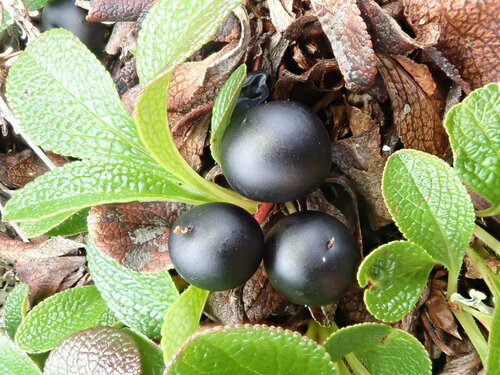
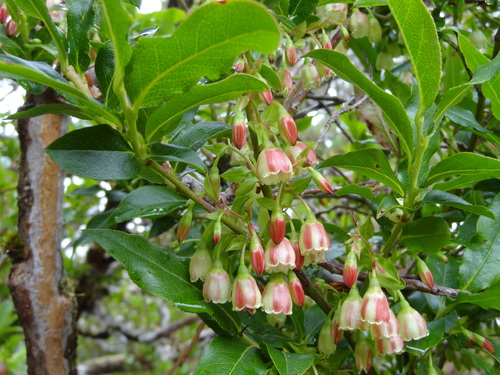
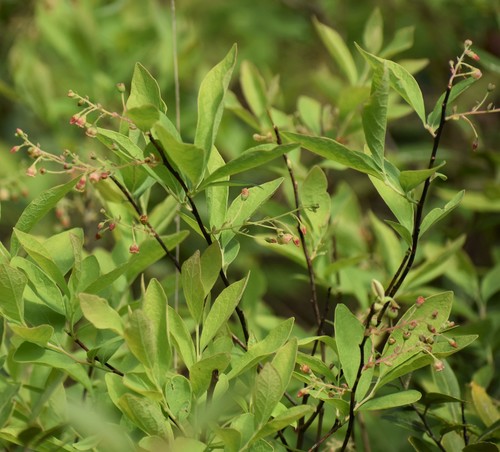
Gaylussacia frondosa, also called dangleberry or blue huckleberry, has round stems that may be brown, green, or red, and can bear some hairs. Its bell-shaped, greenish white flowers bloom in late spring, typically during May and June. Fruiting begins in summer, usually from July to August; during this period, loose hanging fruits change color from green to dark blue and black as they mature. This plant spreads via rhizomes to form small patch colonies, sprouting new stems above ground. Two or more stems may grow from the larger underground rhizome system, usually around 2–6 feet apart. Both the rhizomes and the plant’s roots are most often confined to the humus soil layer. Over time, branching rhizomes form larger colonies of the plant. New separate colonies can form when animals eat the plant’s berries and disperse the seeds. Though it grows in similar habitats and closely resembles Gaylussacia baccata, dangleberry can be distinguished by its often pale green leaves, which are typically much paler on their lower surface than the leaves of G. baccata. When squeezed, leaves of G. baccata release a glandular, sticky yellow resin from both sides, while G. frondosa only produces this resin on the bottom of its leaves. This plant is native to the East coast of the United States, ranging from New Hampshire west and south to Mississippi. It grows in wooded areas, and alongside bogs and swamps. It occurs in wetland regions of the Atlantic and Gulf Coastal Plain, Eastern Mountains and Piedmont, and Northcentral & Northeast. As a shrub, its wetland indicator status is facultative across all three regions it occupies. It is very common in the pine barrens of New Jersey, and the eastern piedmont and coastal plain of North and South Carolina. It most frequently grows in areas with acidic, low-nutrient soils that have a shallow organic layer. Blue huckleberry colonies are often found in habitats including maritime forest, cedar swamp, hardwood swamp, and pine lowland communities. They are also commonly found in disturbed areas such as roadsides and annually burned pinelands. Gaylussacia frondosa often grows near other similar ericaceous shrubs, including highbush blueberry (Vaccinium corymbosum), hillside blueberry (V. pallidum), Lyonia spp., sheep-laurel (Kalmia angustifolia), wintergreen (Gaultheria procumbens), dwarf huckleberry (Gaylussacia dumosa), and black huckleberry (G. baccata). Dangleberry provides both food and shelter for wildlife. Its low shrub growth form offers cover for small mammals and birds. Many bird species including sharp-tailed grouse, greater prairie chicken, wild turkey, and mourning dove, as well as mammals such as black bears and raccoons, eat the plant’s berries. These and other animals disperse the plant’s seeds after consuming the berries. The above-ground stems are also eaten by white-tailed deer and cottontail rabbits. This plant is also valuable for pollinators, especially insect pollinators, which often feed on the nectar of its pink or white spring-blooming flowers. Butterflies are particularly attracted to Gaylussacia frondosa for its flower nectar. Blue huckleberry is a host plant for the larvae of Callophrys henrici, commonly known as Henry's Elfin butterfly, which emerge from February to May. Gaylussacia frondosa is classified as a highly fire tolerant shrub. Low-intensity fires have been observed to encourage vegetative growth and stimulate sprouting in this species. While above-ground portions of the plant are often destroyed by fire, underground rhizomes typically survive and sprout from dormant buds after fire events. This shrub occurs in many habitats that have relatively high fire frequency. Despite being highly fire tolerant, high intensity fires that damage the humus layer may reduce or eliminate blue huckleberry from a site by destroying its underground rhizomes. If the below-ground rhizomes are destroyed, the plant can only recolonize an area through animal-mediated seed dispersal. Additionally, overly frequent fires can also severely damage the plant’s root systems and reduce local shrub populations. The ripe fruits of this plant are edible. The small berries can be picked fresh and eaten raw, or cooked. The fruits can be used to make pudding.